

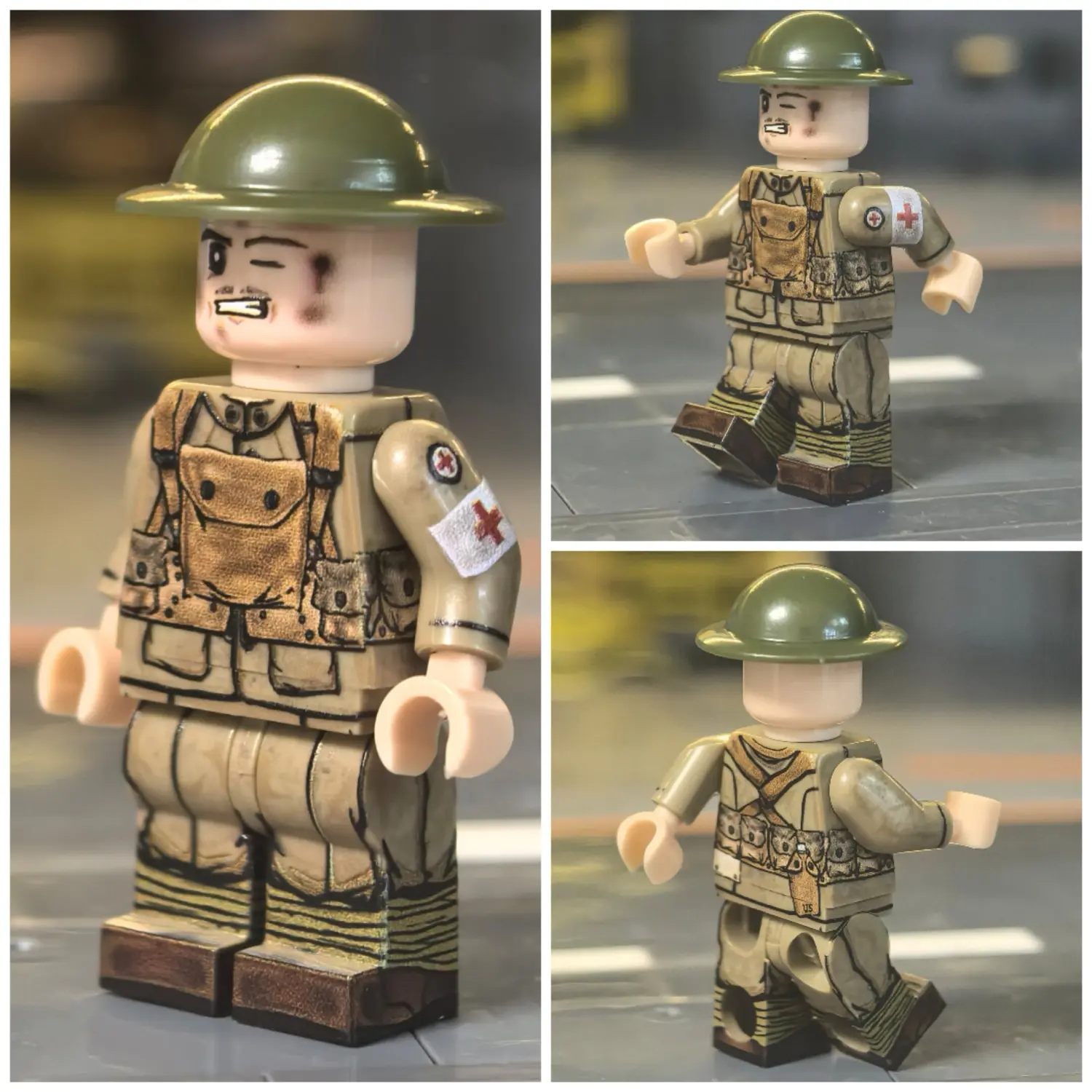
Character Identification: WWI U.S. Army Combat Medic
This custom-printed building block minifigure represents a frontline medical personnel from the United States Army during World War I (WWI). Often referred to affectionately as a “Doughboy,” this specific figure is heavily detailed to represent a combat medic braving the horrific conditions of trench warfare on the Western Front.
Specific Name and Uniform Details
-
Specific Name: WWI United States Army Combat Medic (American Expeditionary Forces)
-
Headgear: The figure wears the iconic olive drab M1917 “Brodie” Helmet. Originally a British design, this shallow, wide-brimmed steel “tin hat” was adopted by the U.S. military to protect soldiers from shrapnel bursting in the air above the trenches.
-
Medical Insignia: The most defining feature of this character is located on his left arm. He wears a printed white armband with a prominent Red Cross, as well as a smaller circular Red Cross patch near the shoulder. Under the Geneva Conventions, this universally recognized symbol identified him as non-combatant medical personnel.
-
The Uniform: He is dressed in the standard U.S. Army khaki/olive wool tunic and trousers. The high-quality 360-degree UV printing features heavy shading and dirt marks, reflecting the muddy, filthy environment of the WWI trenches.
-
Tactical Webbing and Gear: * Chest Pouch: Printed prominently on his chest is a large canvas pouch. In WWI, this placement was typical for the Small Box Respirator (Gas Mask), worn at the “alert” position on the chest so it could be donned in seconds during a chemical gas attack.
-
Webbing: The front and back feature detailed canvas suspenders and a waist belt with multiple pouches, used to carry medical supplies, bandages, and morphine rather than rifle ammunition.
-
-
Footwear: The lower legs feature meticulously printed canvas puttees (long strips of cloth wrapped tightly around the calves) and brown leather trench boots. Puttees were essential for providing ankle support and keeping mud and debris out of the boots.
-
Facial Features: The figure has a heavily battle-worn face, featuring dirt smudges, a winking/squinting eye (perhaps bracing against an explosion or debris), and a grimacing expression, perfectly capturing the stress of frontline duty.
Historical Background
When the United States entered World War I in 1917, the American Expeditionary Forces (AEF), commanded by General John J. Pershing, were sent to Europe to fight alongside the Allies. American infantrymen quickly earned the nickname “Doughboys.”
The battlefields of WWI were defined by brutal trench warfare, relentless artillery barrages, and the horrifying introduction of chemical weapons like mustard gas. In this hellish landscape, the Combat Medic played a vital and incredibly dangerous role.
Armed with little more than bandages, iodine, tourniquets, and a stretcher, these medics were tasked with running into “No Man’s Land” under heavy machine-gun fire to treat and evacuate wounded soldiers. While the Red Cross armband was supposed to protect them from being targeted according to international law, the indiscriminate nature of artillery shells and poison gas meant that medics suffered massive casualty rates alongside the infantrymen they were trying to save.
Reviews
There are no reviews yet