

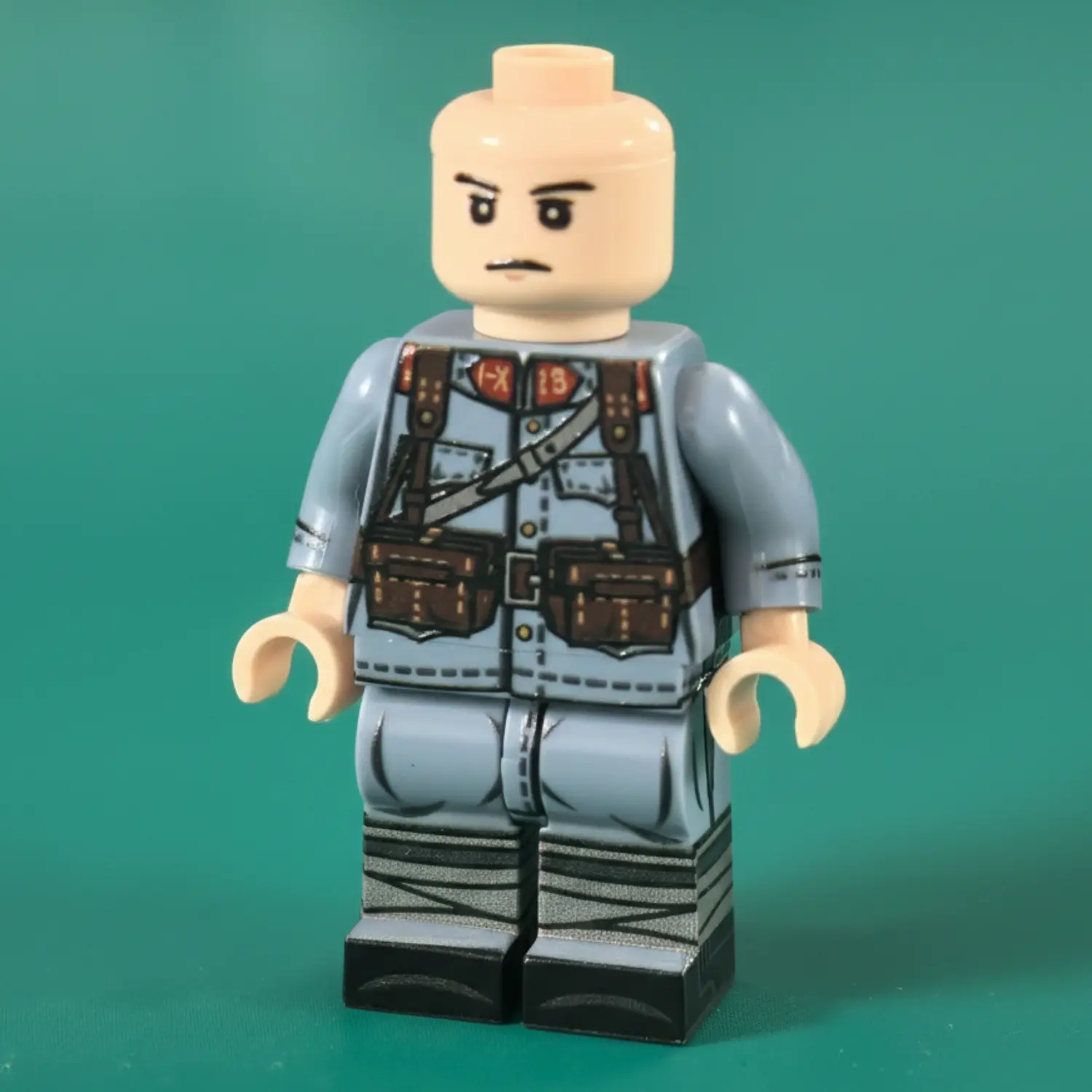
Character Identification
Specific Name: WWI Republic of China Infantryman (Beiyang Army – Standard Regular)
This figure represents a standard enlisted soldier of the Beiyang Army (North China Army) during the World War I era (approx. 1912–1920). Unlike the previous figure which featured the specific “War Participation” sash, this figure depicts the regular combat attire of the Chinese Republican forces that aligned with the Allied Powers.
Visual Description
This custom-printed minifigure accurately depicts the standard issue field uniform of the early Republic of China:
-
Uniform Color: He wears the iconic Beiyang Grey (Blue-Grey) Tunic and trousers. This distinct shade was the universal color for Chinese northern armies during the Warlord Era, distinguishing them from the Khaki-wearing colonial powers or the later Nationalist blue.
-
Collar Insignia (Rank & Branch): The most defining feature is the Red Rectangular Collar Tabs.
-
Color: In the Beiyang system, Red specifically denoted Infantry.
-
Markings: The yellow/gold characters on the tabs (visible as “1-X 13” or similar) indicate his unit designation (Regiment/Battalion numbers), marking him as a regular soldier in a structured division.
-
-
Tactical Gear:
-
Y-Straps: He wears brown leather Y-Strap Suspenders, a style of webbing influenced by German military advisors who trained the Beiyang Army.
-
Ammo Pouches: Standard brown leather Mauser Cartridge Pouches are printed on his belt, designed to hold stripper clips for the Hanyang 88 or Mauser Type 13 rifles.
-
-
Legwear:
-
Puttees: The lower legs feature detailed printing of grey Leg Wrappings (Puttees) tied with black cords. This was essential field gear for soldiers in the early 20th century to protect the legs and support hiking.
-
-
Face: The figure features a simple, serious expression with a thin mustache, typical of the era’s military grooming standards.
Historical Background
-
The Beiyang Army: Originally created by Yuan Shikai, this was the first modernized army in China. By World War I, it was the de facto military of the recognized Chinese government in Beijing.
-
WWI Alignment: In 1917, this government declared war on Germany, hoping to recover German concessions in Shandong province. While they mainly sent laborers (the Chinese Labour Corps) to France, they maintained a standing army equipped like this figure to protect Allied interests in East Asia and participate in the Allied intervention in Siberia (1918).
-
Warlord Era: After WWI, these soldiers became the primary foot soldiers in the chaotic Warlord Era, fighting in massive internal conflicts across China.

Reviews
There are no reviews yet