

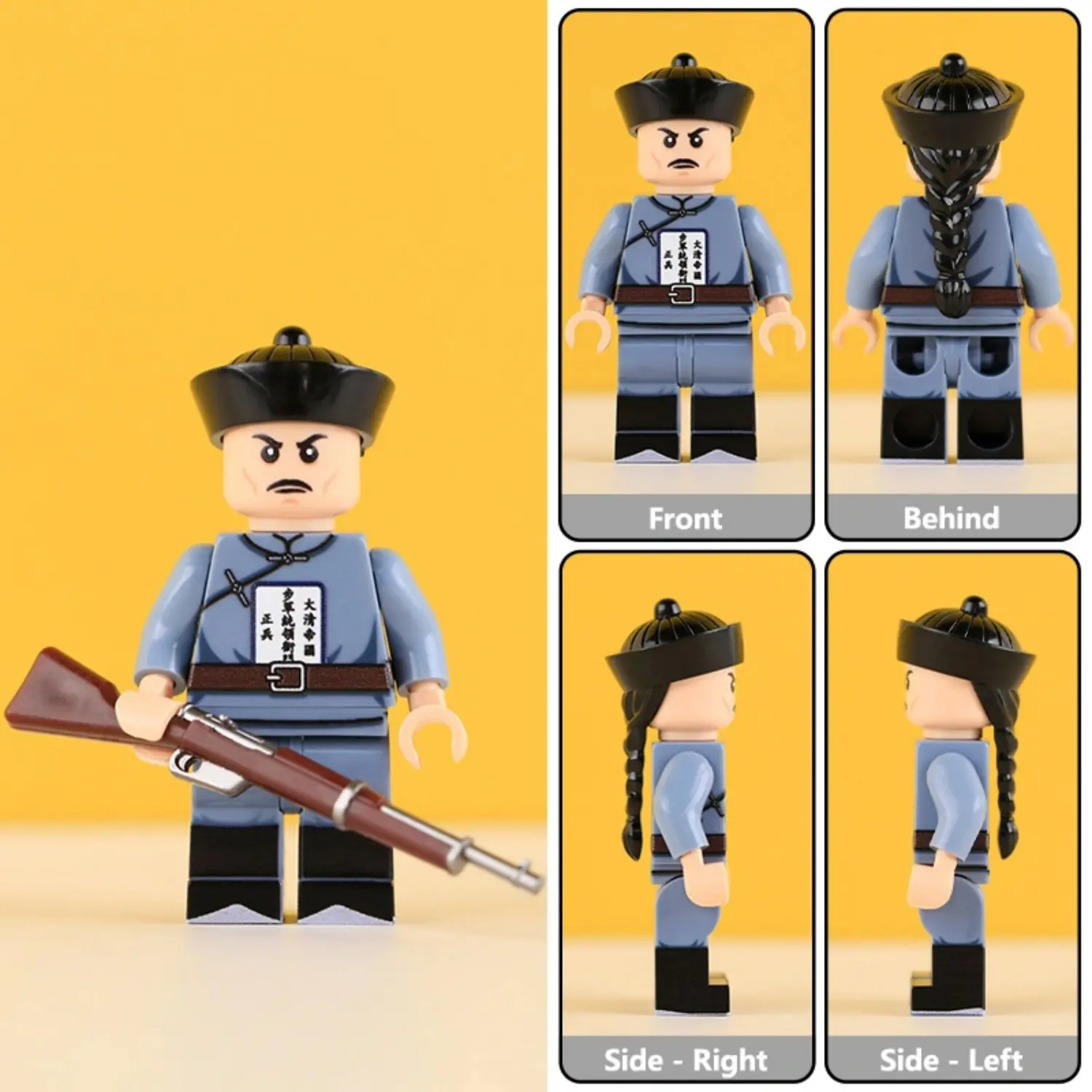
This custom building block minifigure specifically represents a Qing Dynasty Infantry soldier, and more accurately, a capital guard from the late Imperial Chinese era. Visually, the character is dressed in a traditional light blue military tunic featuring a side-fastening collar design, secured at the waist by a simple brown printed belt. The most prominent and historically specific feature is the large white rectangular chest patch printed with black Chinese characters. These characters proudly read “大清帝国” (Great Qing Empire), “步军统领衙门” (Office of the General Commandant of the Infantry), and “正兵” (Regular Soldier), which historically served to visibly identify the soldier’s specific unit, allegiance, and rank directly on his uniform. On his head, he wears a traditional black Qing soldier’s hat with an upturned brim and a ribbed crown. Turning to the back, the figure features the historically mandated black queue, which is the long braided ponytail strictly required by the ruling Manchu government. His outfit is completed with blue trousers and classic black boots with white soles, and despite his deeply traditional attire, he is equipped with a modern bolt-action rifle accessory.
Historically, this figure perfectly captures the complex transitional phase of the late Qing Dynasty’s military forces. The “Office of the General Commandant of the Infantry,” also known as the Peking Gendarmerie, was an elite traditional force responsible for the law enforcement, security, and defense of the imperial capital city of Beijing. As the empire faced severe internal rebellions and external threats from foreign powers in the late 19th and early 20th centuries, these capital guards were increasingly equipped with cutting-edge imported firearms, such as the bolt-action rifle depicted here. However, while they wielded advanced modern weapons, they were still strictly required by the imperial court to wear traditional military garments—including the unit chest patch and the Manchu queue—to demonstrate absolute, unwavering political loyalty to the Emperor. This infantryman perfectly embodies an era where ancient imperial traditions clashed directly with the dawn of modern warfare.

Reviews
There are no reviews yet