

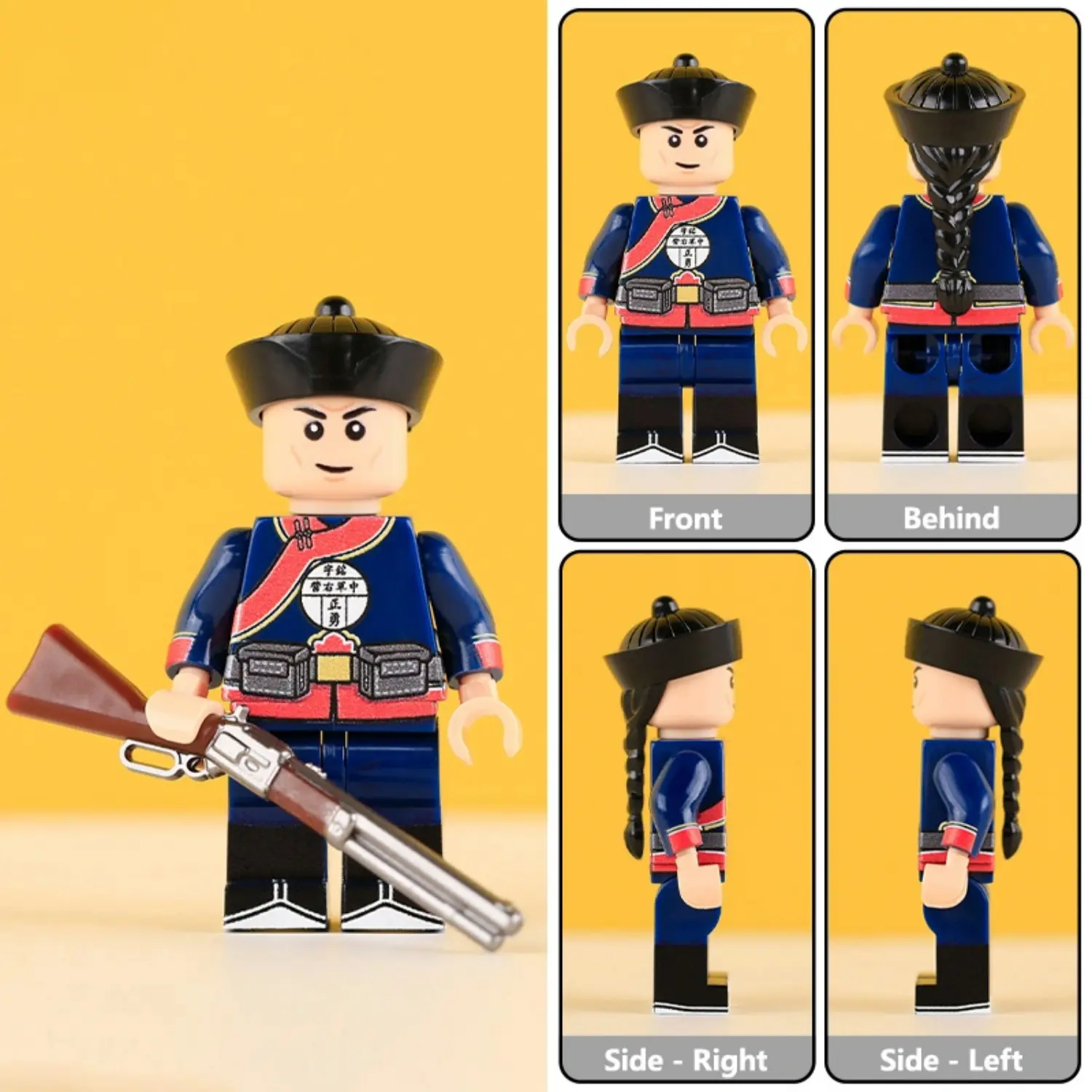
This custom building block minifigure specifically represents a Qing Dynasty Huai Army Soldier from the late Imperial Chinese era. Visually, the character is dressed in a traditional dark blue military tunic featuring distinctive red trim around the collar, cuffs, and lower hem, secured with traditional side-fastenings. The most crucial historical identifying feature is the prominent white circular patch printed squarely on his chest, which displays black Chinese characters that historically indicated the soldier’s specific battalion, regiment, and status as a regular brave. Around his waist, he wears a red sash accompanied by a printed belt equipped with modernized grey ammunition pouches to feed his weapon. His headgear consists of the classic black Qing soldier’s hat with an upturned brim and ribbed crown, and turning the figure to the back reveals the historically mandated black braided queue (ponytail), which was strictly required by the Manchu rulers. His outfit is completed with matching dark blue trousers and traditional black cloth boots with white soles, and he is heavily armed with a highly detailed, Western-imported lever-action repeating rifle accessory.
Historically, the Huai Army (also known as the Anhui Army) was a powerful regional military force originally raised by the prominent statesman Li Hongzhang during the devastating Taiping Rebellion in the 1860s. Because the traditional imperial armies had repeatedly failed to suppress the massive rebellions, regional leaders were permitted by the imperial court to raise these highly loyal, private militia-style armies. The Huai Army became one of the most vital and powerful military forces of the late Qing Dynasty and was at the very forefront of the Self-Strengthening Movement. They were among the very first Chinese troops to be heavily equipped with advanced foreign weapons, such as the devastating American lever-action rifles depicted here, which provided immense rapid-fire capabilities compared to older single-shot muskets. However, despite wielding these cutting-edge imported firearms and wearing modern ammunition pouches, the soldiers were still strictly required to wear deeply traditional Qing military uniforms with circular unit identifiers and maintain the Manchu queue hairstyle. This figure perfectly illustrates the empire’s fascinating and chaotic blend of ancient imperial tradition colliding directly with rapid, late 19th-century industrial modernization.
Reviews
There are no reviews yet