

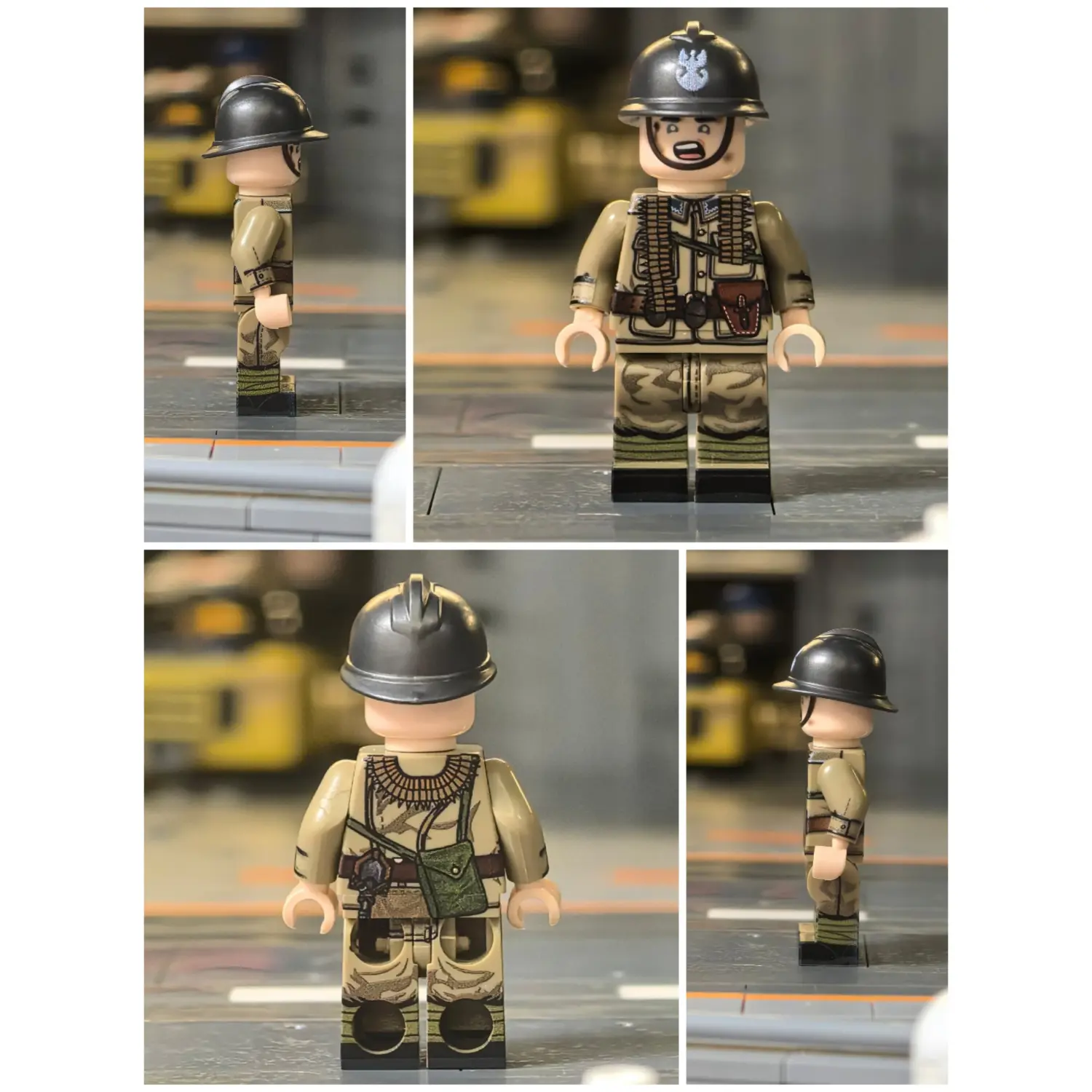
The Figure: WWII Polish Heavy Machine Gunner (Celowniczy Ckm)
This toy minifigure represents a specialized Non-Commissioned Officer (NCO) of the Polish Army during the 1939 Defensive War. Judging by the filename (“wz30”) and his equipment, he is the lead gunner or squad leader for a Ckm wz. 30 Heavy Machine Gun crew.
-
Headgear: He wears the dark green Wz.15 Adrian Helmet featuring the painted White Eagle (Orzeł Biały) on the front.
-
Historical Note: While regular Polish riflemen often wore the newer Wz.31 helmet, specialized troops like heavy machine gun crews, artillerymen, and cavalry continued to use the French-style Adrian helmet extensively during the German invasion.
-
-
The Ammo Belts (Key Feature): The defining detail of this figure is the Machine Gun Ammunition Belts printed across his chest and around his neck.
-
These belts hold the 7.92mm rounds used in the Ckm wz. 30 (a Polish clone of the American Browning M1917 water-cooled machine gun). Carrying extra ammo draped over the body was a common practice for gun crews to ensure rapid reloading during combat.
-
-
Uniform: He wears the standard Khaki Field Tunic.
-
Collar Tabs: The Blue Zig-Zag Patches (Patki) on the collar confirm he belongs to an Infantry regiment.
-
Sidearm: On his belt, there is a printed Brown Leather Pistol Holster. Machine gunners and NCOs were typically issued pistols (like the Vis wz. 35) for personal protection because their primary weapon (the heavy machine gun) was stationary and cumbersome.
-
-
Face: The figure has an Action/Shouting Expression with a chinstrap printed on the face, capturing the intensity of commanding a gun crew under fire.
Historical Background: The Ckm wz. 30 was the backbone of Polish infantry defense. These heavy machine guns were vital in holding defensive lines against German infantry waves. A soldier like this would have been a high-priority target, manning his post in a bunker or trench. The combination of the “old school” Adrian helmet with the desperate firepower of the heavy machine gun perfectly symbolizes the Polish resistance of September 1939—fighting with determination against a technologically superior enemy.

Reviews
There are no reviews yet