

Character Identification
Specific Name: Late Qing Dynasty Imperial Soldier / Bannerman (Manchu Army Infantry)
Unlike the previous figures that identified specific units via text, this soldier appears to represent a member of the Eight Banners or a modernized regular infantryman, distinguished by a more ornate uniform style typical of the late 19th-century Imperial Army.
Visual Description
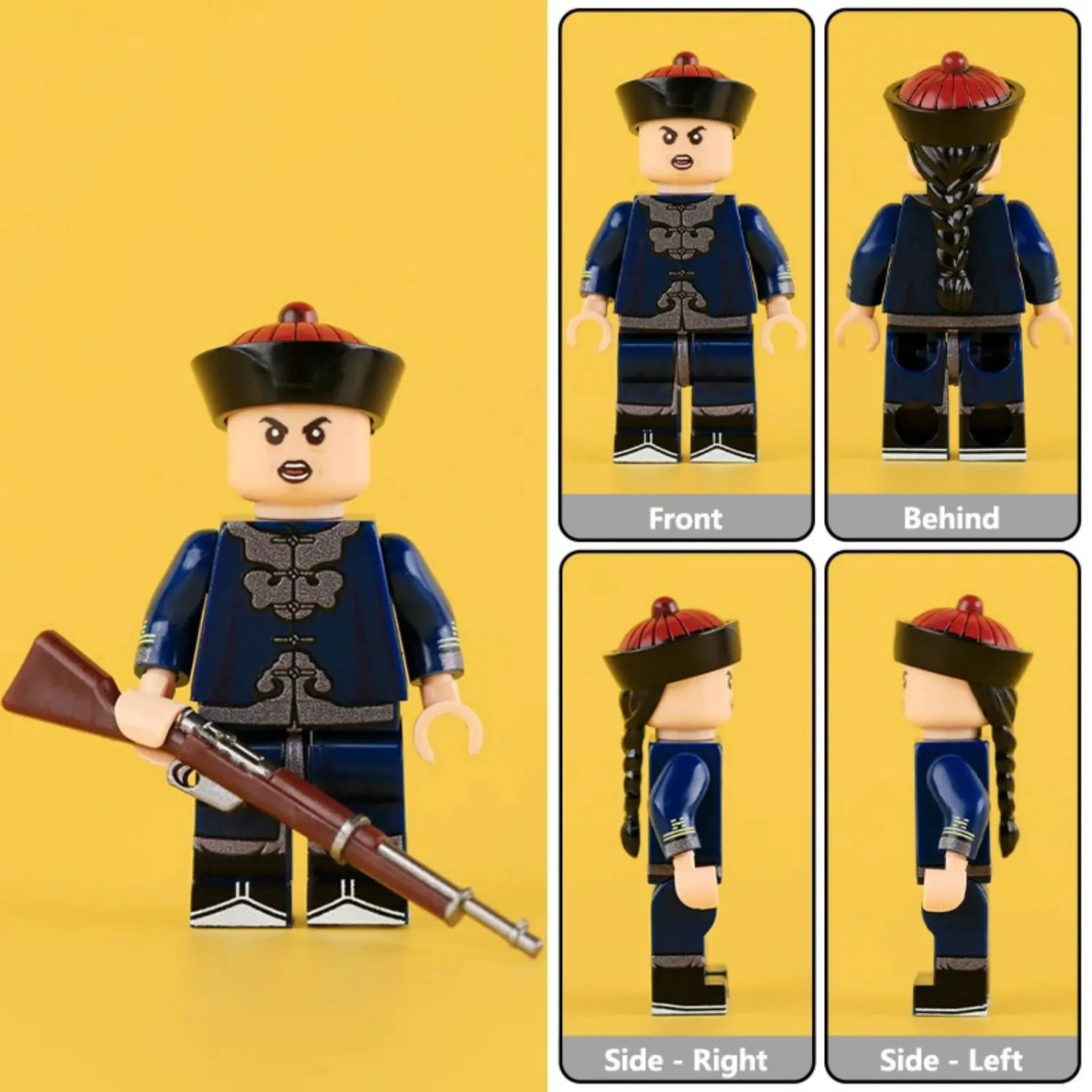
This custom-printed minifigure perfectly illustrates the clash of eras in late Imperial China, where ancient traditions met modern warfare:
-
Headgear (Official Cap): He wears the traditional Black Official’s Hat with an upturned brim. A distinct Red Finial (Knob) sits on the very top. In the Qing rank system, the material and color of this knob indicated rank, though for common soldiers, it was often just a red tassel or knot.
-
The Queue (Manchu Braid): The rear view clearly shows the long black Queue (Pigtail) braided down his back. This hairstyle was mandatory for all males in the Qing Empire. Losing it was a capital offense, while cutting it off voluntarily became a symbol of rebellion during the 1911 Revolution.
-
Uniform:
-
Design: He wears a Dark Blue Tunic with elaborate Grey/Silver Embroidery on the chest and collar, resembling stylized clouds or traditional knot patterns. This is more decorative than the functional uniforms of the “New Army” (like MTUV104), suggesting he might belong to the older “Green Standard Army” or a Banner unit that was recently equipped with rifles.
-
-
Weapon: Despite the traditional clothes, he carries a modern Bolt-Action Rifle (resembling a Hanyang 88 or Mauser). This contrast defines the “Self-Strengthening Movement” era, where the Qing court desperately tried to modernize their army’s technology while preserving their cultural identity.
-
Footwear: He wears the standard black cloth boots with white soles, designed for marching on China’s rough terrain.
Historical Background
-
The Eight Banners: The “Bannermen” were the hereditary military caste of the Qing Dynasty. By the late 1800s, they had largely declined in fighting ability, but efforts were made to retrain them with Western firearms to face foreign powers and internal rebellions (like the Boxers).
-
The “Self-Strengthening” Era: This figure represents a soldier from the 1890s-1900s. The Qing government bought thousands of rifles from Germany (Mausers) and produced their own (the Hanyang Arsenal).
-
The End of an Era: A soldier like this would have fought in the First Sino-Japanese War (1894) or the Boxer Rebellion (1900). Within a decade of this figure’s historical setting, the Qing Dynasty would fall, and the queue would be cut off forever.
Reviews
There are no reviews yet