

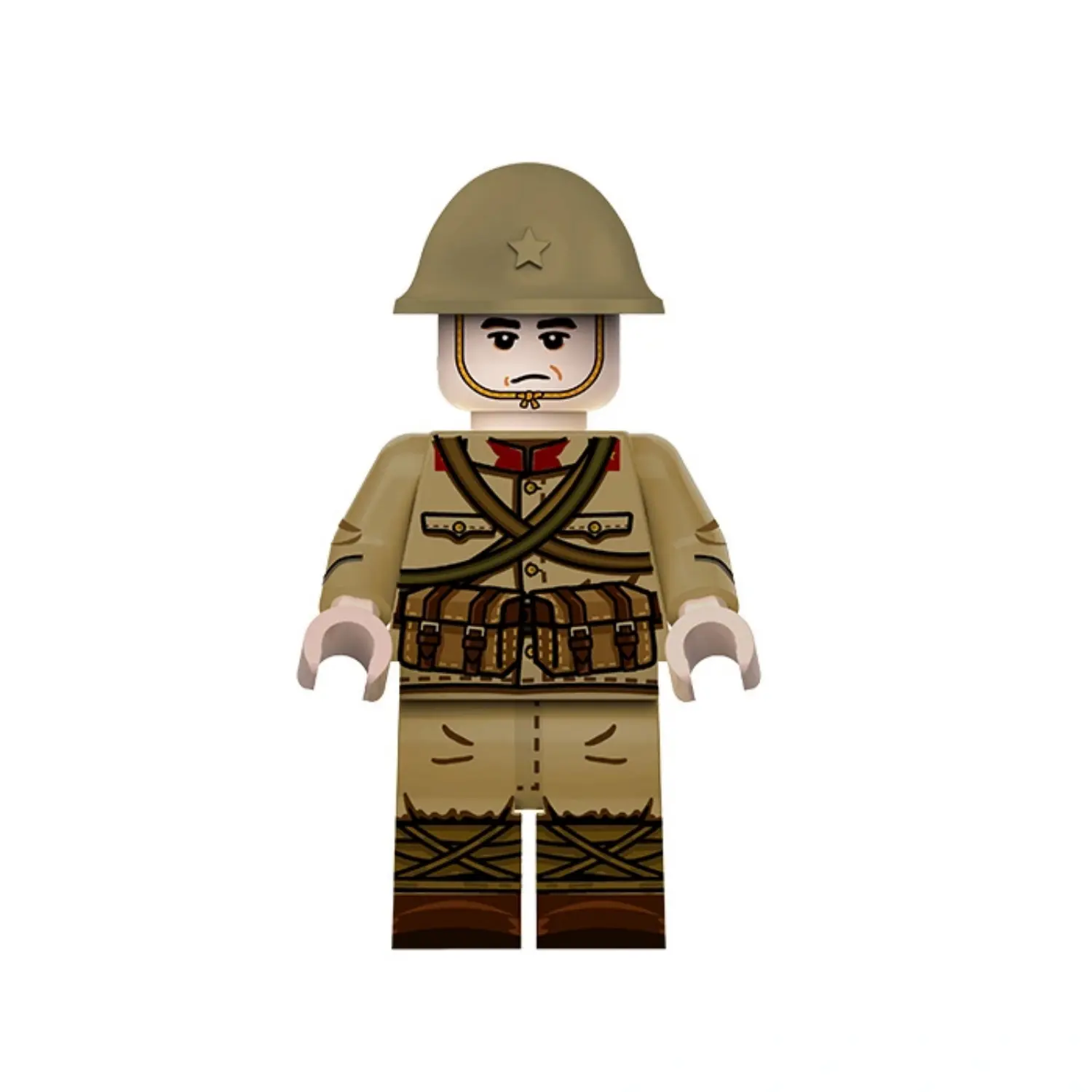
Character Identification: WWII Imperial Japanese Army Infantry Rifleman
This custom-printed building block minifigure represents a standard frontline enlisted soldier of the Imperial Japanese Army (IJA) during World War II. The uniform, headgear, and specific arrangement of the tactical webbing are highly characteristic of a fully equipped Japanese rifleman fighting in the Pacific Theater or the Asian mainland.
Specific Name and Visual Details
-
Specific Name: WWII Imperial Japanese Army (IJA) Infantry Rifleman (Heavy Ammo Loadout)
-
Headgear (The Type 90 Helmet): The figure wears the standard Type 90 Steel Helmet (Tetsubou), painted in a matte khaki/olive-drab color. It features the prominent five-pointed star insignia of the IJA on the front. A printed chin strap is visibly secured underneath the figure’s jaw.
-
Facial Features: The printed face shows a stoic, disciplined, and slightly weathered expression, representing a hardened veteran soldier.
-
The Uniform (Type 98): He is dressed in the standard-issue Type 98 (M98) uniform in a khaki/mustard-yellow color, which was the ubiquitous field dress for Japanese forces from 1938 onward.
-
Insignia: The collar features red collar tabs with gold stars. In the IJA ranking system, red designated the Infantry branch, and the stars indicated the specific enlisted rank.
-
Tactical Webbing and Gear (The Defining Feature):
-
Unlike other variants, this figure features criss-crossing canvas suspender straps over the chest, designed to support heavy gear.
-
Around his waist is a brown combat belt fitted with three prominent brown leather ammunition pouches lined up across the front. Historically, a Japanese rifleman carried two front cartridge boxes and one larger rear reserve box, but clustering them on the front is a common visual shorthand in models to depict a heavily armed frontline soldier carrying stripper clips for his Arisaka rifle.
-
-
Lower Body and Footwear: The legs feature detailed printing of Kyahan (cloth puttees/leg wraps) with distinctive criss-cross tie strings. These were worn over the trousers to protect the shins from jungle brush, insects, and mud. He wears standard brown leather military boots.
Historical Background
During World War II, the Empire of Japan fielded millions of soldiers across a vast and unforgiving theater of war, stretching from the frozen borders of the Soviet Union to the sweltering, disease-ridden jungles of the South Pacific.
-
The Backbone of the Army: The standard infantry rifleman was the core of the Japanese war machine. Armed typically with a Type 38 or Type 99 Arisaka bolt-action rifle, these soldiers were known for their fierce discipline, extreme physical endurance, and ability to survive on very limited logistical supplies.
-
The Webbing and Pouches: The heavy leather ammunition pouches depicted on this figure were essential. Because Japanese troops often operated far ahead of their supply lines using rapid infiltration tactics, a soldier had to carry all of his necessary combat ammunition on his person. The criss-cross canvas straps helped distribute the heavy weight of the lead cartridges.
-
Uniform Adaptability: The Type 98 uniform was designed to be versatile. In colder climates, heavy wool layers and coats were added, but in the Pacific, soldiers often wore the lightweight cotton version depicted here, relying on the Kyahan leg wraps to keep out leeches and jungle rot.
Reviews
There are no reviews yet