

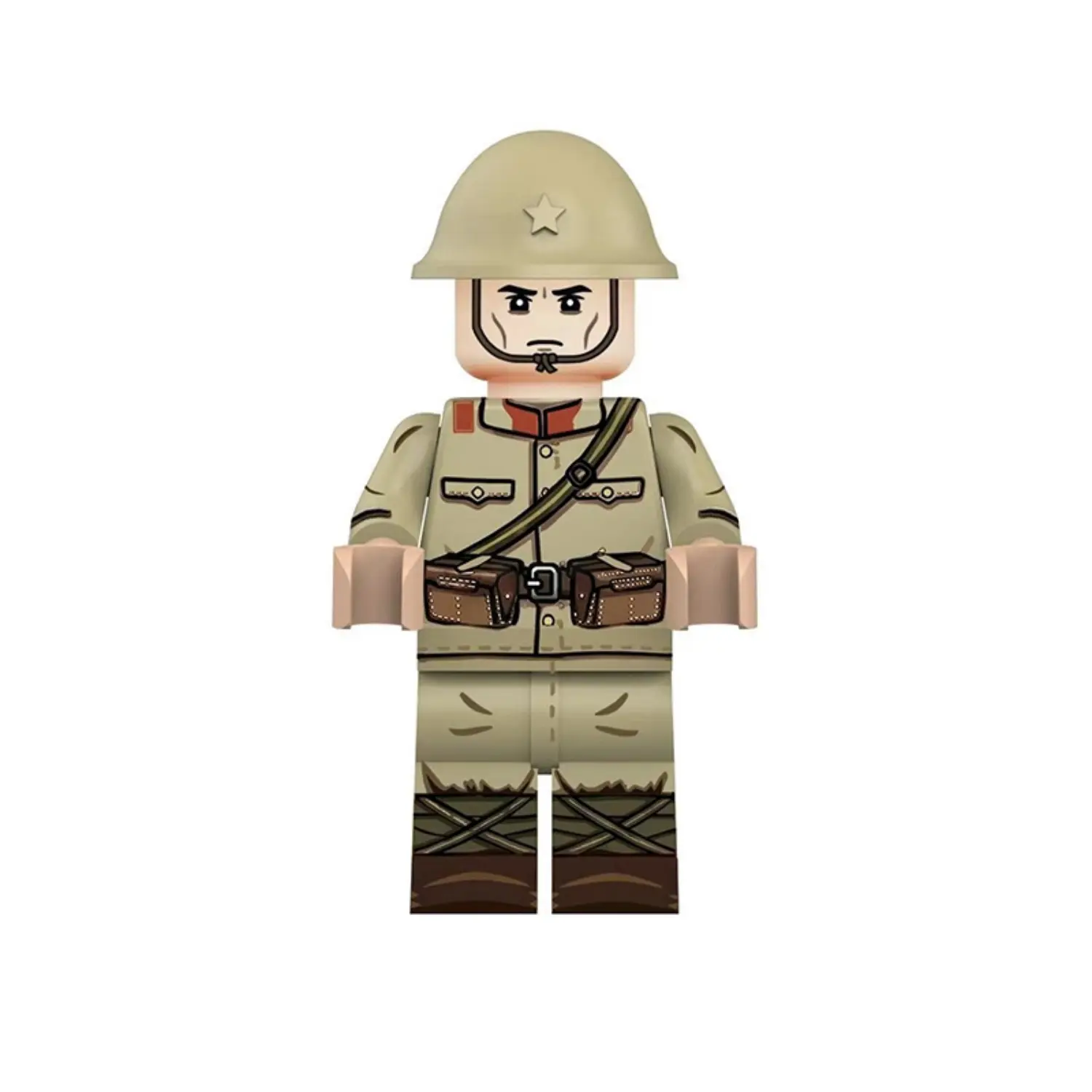
Character Identification: WWII Imperial Japanese Army (IJA) Battle-Worn Soldier
This custom-printed building block minifigure represents a rugged, frontline combatant of the Imperial Japanese Army (IJA) during World War II. While the manufacturer’s filename labels this as a “War Correspondent,” the visual printing strongly depicts a battle-worn infantryman, NCO, or specialist equipped for long deployments in the harsh environments of the Pacific Theater or the Asian mainland.
Specific Name and Uniform Details
-
Specific Name: WWII Imperial Japanese Army Battle-Worn Soldier / Specialist (Type 98 Uniform)
-
Headgear: The figure wears the standard-issue Type 90 Steel Helmet (Tetsubou) in a khaki color. It proudly displays the five-pointed star insignia of the Japanese Army on the front. A printed chinstrap secures the helmet tightly to his head.
-
Facial Features: The printed face features a stern, intense, and somewhat exhausted expression with defined cheek lines, capturing the grim reality of a veteran frontline soldier.
-
The Uniform: He is dressed in the standard Type 98 summer tunic in a faded khaki color. On his collar, he wears pointed red collar tabs, which officially designated him as a member of the Infantry branch.
-
Tactical Gear: He wears a printed brown leather belt with a metal buckle. Attached to the belt are two brown leather utility pouches. Unlike standard riflemen, he features a single diagonal equipment strap crossing his chest from his left shoulder to his right hip. (In the context of the “War Correspondent” title, this strap would historically hold a map case or a field camera, though it could also represent an officer’s dispatch bag or binocular strap).
-
Lower Body (Battle Damage): The most defining feature of this specific figure is the heavy wear on his uniform. The khaki trousers feature ragged, torn edges just above the knees, simulating a uniform that has been ripped and worn down by harsh jungle terrain.
-
Footwear: Beneath the torn trousers, he wears the standard cross-wrapped canvas puttees (leg wrappings) leading down to dark brown combat boots.
Historical Background
During World War II, the Imperial Japanese Army (IJA) conducted massive military campaigns across incredibly hostile and unforgiving terrains, from the dense, malaria-infested jungles of Burma and New Guinea to isolated atolls in the Pacific Ocean.
-
The Type 98 Uniform: Introduced in 1938, the Type 98 became the iconic uniform of the Japanese soldier during WWII. Designed with a fold-down collar for comfort in hot climates, it utilized colored collar tabs to denote the soldier’s branch (red for infantry, the primary combat force).
-
Supply Line Failures and Ragged Uniforms: The torn and ragged trousers depicted on this minifigure reflect a highly accurate historical reality. As the war progressed, the Japanese military’s logistical supply lines were decimated by Allied naval and air power. Soldiers stationed on remote islands were often cut off from resupply for months or even years. They were forced to fight, march, and survive in the exact same uniform, which quickly rotted, tore, and degraded in the abrasive, humid jungle environment.
-
Canvas Puttees: The cloth strips wrapped around the calves were essential survival gear. They provided critical ankle support for long marches and helped prevent leeches, tropical insects, and sharp brush from cutting the soldiers’ legs.
Reviews
There are no reviews yet