

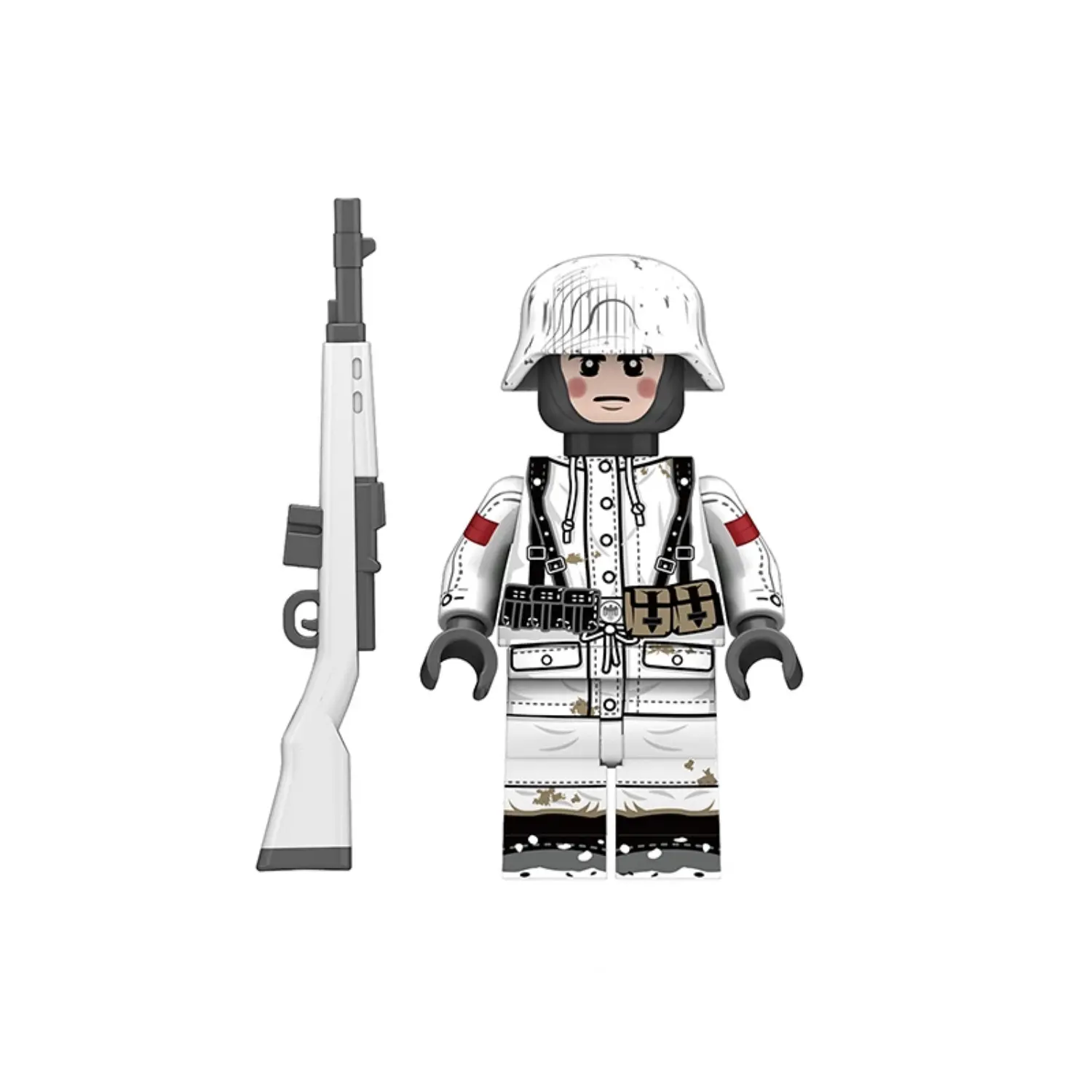
Character Identification
Specific Name: WWII German Wehrmacht Winter Marksman / Infantryman (Equipped with Gewehr 43 / G43 Semi-Automatic Rifle)
The text printed on the image explicitly labels this figure as “N693 German Winter Soldier-G43”. This represents a German soldier from the mid-to-late war period (1943–1945), equipped with a semi-automatic rifle for higher firepower on the frozen front lines.
Visual Description
This figure features specific winter survival gear and weaponry that distinguishes him from the standard rifleman:
-
Headgear: He wears a Whitewashed Stahlhelm (Steel Helmet) to blend in with the snowy terrain. Underneath the helmet, you can see a black or dark grey Balaclava (Toque) covering his neck and ears. This is a crucial detail representing the extreme cold of the Eastern Front or the Ardennes winter.
-
Face: The face print features Rosy/Red Cheeks, visually depicting the effect of freezing temperatures on the soldier’s skin.
-
Uniform: He is dressed in a full White Winter Snow Suit (Schneeanzug). Unlike the “mixed” camo figures, this soldier is fully clad in white for maximum concealment in deep snow.
-
Gear:
-
Pouches: He wears specialized G43 Ammunition Pouches on his belt. These are distinct from the standard Kar98k pouches, usually appearing as dual-pocket leather or canvas pouches designed to hold the G43 magazines.
-
Armbands: Red bands are visible on his arms, a common field identification marking.
-
-
Weapon: He is armed with the Gewehr 43 (G43), also known as the Karabiner 43 (K43). The rifle is easily identified by the detachable box magazine protruding from the bottom, distinguishing it from the bolt-action Kar98k. The weapon is painted White for snow camouflage.
Historical Background
-
The Weapon (G43): The Gewehr 43 was introduced in 1943 as a response to the Soviet SVT-40 and American M1 Garand. It gave German infantrymen semi-automatic capability, allowing for faster follow-up shots without working a bolt. It was typically issued to designated marksmen or squad leaders.
-
Winter Warfare: The inclusion of the balaclava and full snow suit highlights the lessons learned from the disastrous first winter in Russia (1941). By 1943/44, the Wehrmacht was better equipped with winter clothing to survive temperatures that could drop to -40°C.
-
Tactical Role: A soldier with a G43 would provide suppressing fire to cover the movement of bolt-action riflemen. The white camouflage on both the suit and the rifle indicates this unit is set up for ambush tactics in a snow-covered theater like the Battle of the Bulge or the defensive battles in Poland and East Prussia.
Reviews
There are no reviews yet