

Variations
Introduction
Group Identification: WWII German Waffen-SS Infantry Squad (Late War)
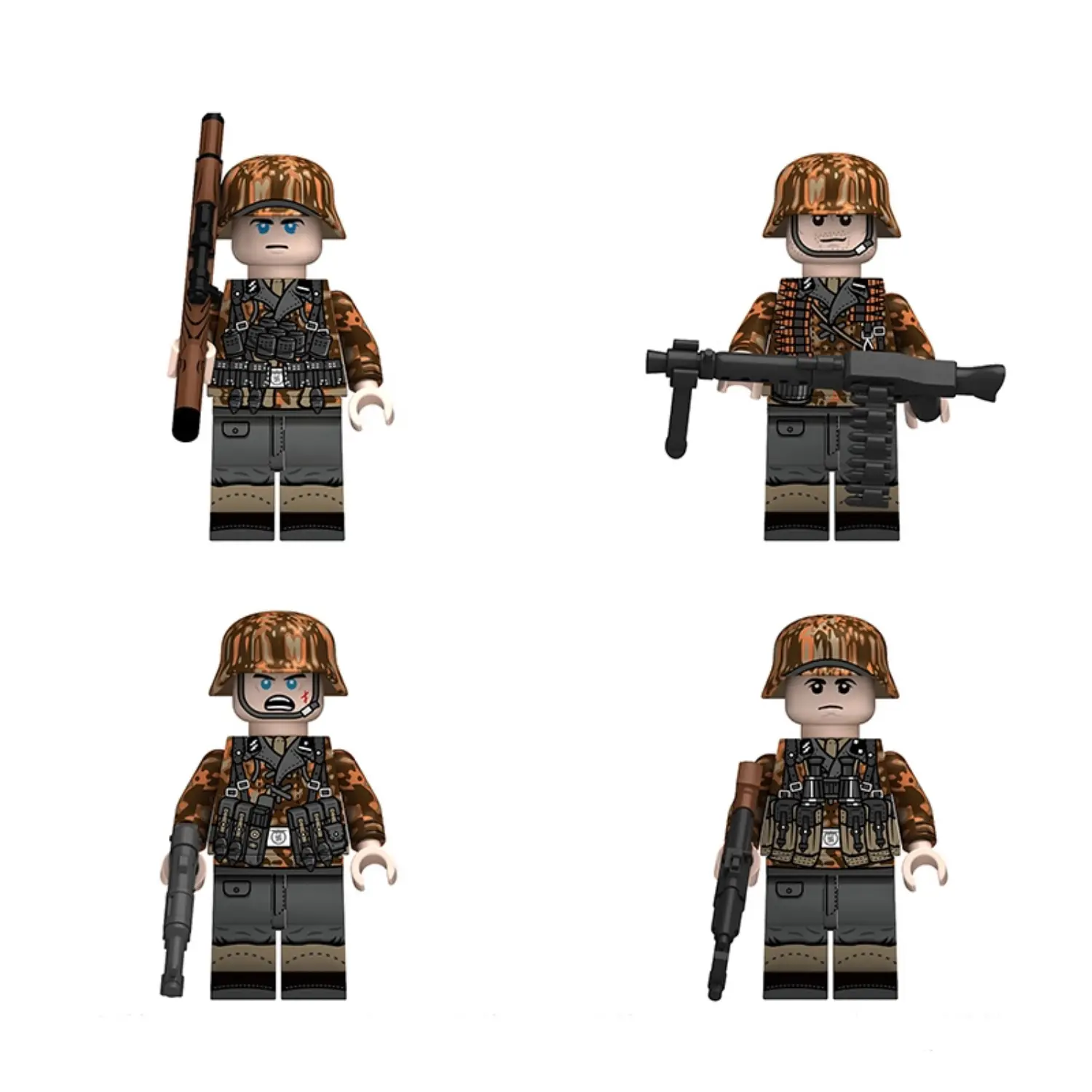
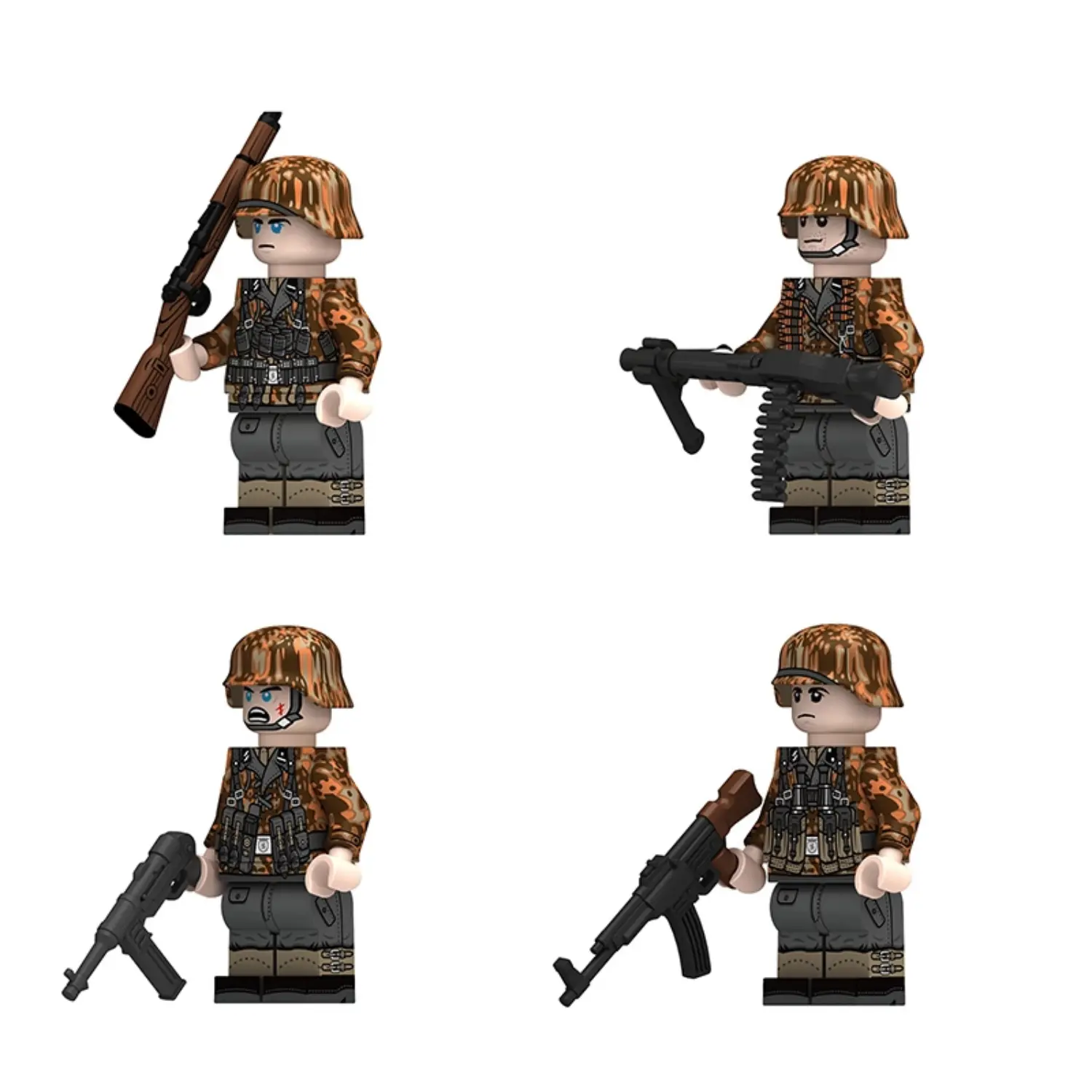
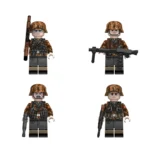
This image displays a set of four highly detailed custom-printed building block minifigures representing a specialized combat squad of the Waffen-SS during the later stages of World War II. All four figures share common late-war uniform elements: Stahlhelm (Steel Helmets) with camouflage covers, field grey (Feldgrau) trousers, printed canvas gaiters (Gamaschen) over ankle boots, and the iconic SS lightning bolt runes visible on their right collar tabs beneath their smocks.
Most notably, all figures are equipped with the distinct Rauchtarnmuster (“Smoke Edge”) camouflage in its brownish-orange Autumn (Herbst) color palette.
Here is a detailed, one-by-one breakdown of the figures, moving clockwise from the top left:
1. Top Left: The Standard Rifleman
-
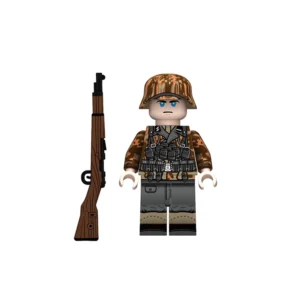
Specific Name: WWII German Waffen-SS Rifleman (Rauchtarnmuster Autumn 98K)
-
Visual Details: This figure represents the backbone of the German infantry. He has a calm expression with bright blue eyes. Over his autumn camouflage smock, he wears a black leather Y-strap harness. Around his waist are standard triple-cell Kar98k ammunition pouches. Additionally, he wears a printed cloth bandolier across his chest for carrying extra ammunition clips.
-
Weaponry: He is holding a molded plastic Karabiner 98k (Kar98k), featuring a printed wood-grain texture.
-
Historical Context: The bolt-action Kar98k was the standard-issue service rifle for the German military throughout the entire war. Because it was a bolt-action weapon, German riflemen relied heavily on extra ammo bandoliers to maintain sustained fire to support their squad’s machine gunners.
2. Top Right: The Heavy Weapons Specialist
-
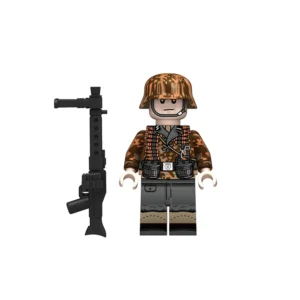
Specific Name: WWII German Waffen-SS Machine Gunner (Rauchtarnmuster Autumn MG34)
-
Visual Details: This figure features a gritty, unshaven face with a printed chinstrap, reflecting the exhausting burden of his role. Draped heavily across his chest are printed linked ammunition belts. Attached to his front belt are two cylindrical carriers for the Gurttrommel (50-round assault drums).
-
Weaponry: He is holding a highly detailed, black plastic Maschinengewehr 34 (MG 34), complete with a cooling jacket and bipod.
-
Historical Context: German WWII infantry tactics were entirely built around the squad machine gunner. The MG 34 provided the vast majority of a squad’s firepower. The gunner carried an immense physical burden, hence the extra ammo belts and assault drums printed on his torso, which allowed him to lay down suppressive fire on the move.
3. Bottom Right: The Assault Squad Leader
-
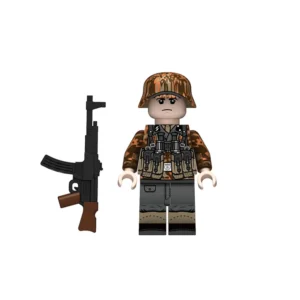
Specific Name: WWII German Waffen-SS Assault Rifleman (Rauchtarnmuster Autumn STG44)
-
Visual Details: This figure features a disciplined, neutral expression. Resting prominently on his upper chest is a printed pair of military binoculars, indicating he is likely a squad leader (Gruppenführer) or scout. Around his waist, he wears highly specific StG 44 magazine pouches, which feature three tall, vertical canvas cells on each side to hold long, curved magazines.
-
Weaponry: He is holding the Sturmgewehr 44 (StG 44), molded with a brown stock/grip and curved magazine.
-
Historical Context: Introduced late in the war, the StG 44 was the world’s first successful assault rifle, revolutionizing modern infantry combat. Because its magazines were uniquely shaped, soldiers required specially manufactured, elongated pouches, which are accurately depicted on this figure.
4. Bottom Left: The Close-Quarters Fighter
-
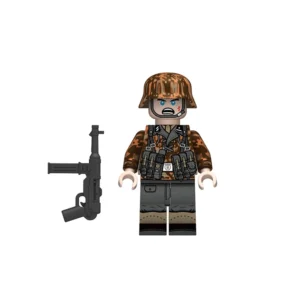
Specific Name: WWII German Waffen-SS Submachine Gunner (Rauchtarnmuster Autumn MP40)
-
Visual Details: This figure features an intense, yelling expression, capturing the heat of battle. He has a printed chinstrap and a bleeding red scar or cut on his left cheek. His belt features specific MP38/40 magazine pouches (three tall, vertical cells designed for straight stick magazines).
-
Weaponry: He holds a molded black MP40 (Maschinenpistole 40) with the folding stock retracted.
-
Historical Context: The MP40 was a devastating submachine gun used in close-quarters combat, urban warfare, and trench clearing. It was typically issued to NCOs, squad leaders, and mechanized infantry. The battle-scarred face perfectly suits the aggressive, close-range nature of an MP40 gunner.
Historical Background: Late-War Camouflage & Gear
-
Rauchtarnmuster (Smoke Edge) Camouflage: The Waffen-SS pioneered the widespread use of combat camouflage. Introduced around 1939, this pattern was designed to blur the human silhouette in forested areas. The garments were typically reversible; the Autumn side (depicted on these figures) utilized brownish-orange and charcoal hues to blend in with dead leaves, mud, and fall foliage.
-
The Transition in Footwear: The printed canvas gaiters and short ankle boots on all four figures are a distinct hallmark of the late war. Early in the conflict, soldiers wore the famous tall leather “Jackboots.” As the war dragged on and leather shortages crippled the German supply lines, the military transitioned to cheaper short boots paired with cloth leg wrappings to conserve materials.
Reviews
There are no reviews yet