

Variations

Introduction
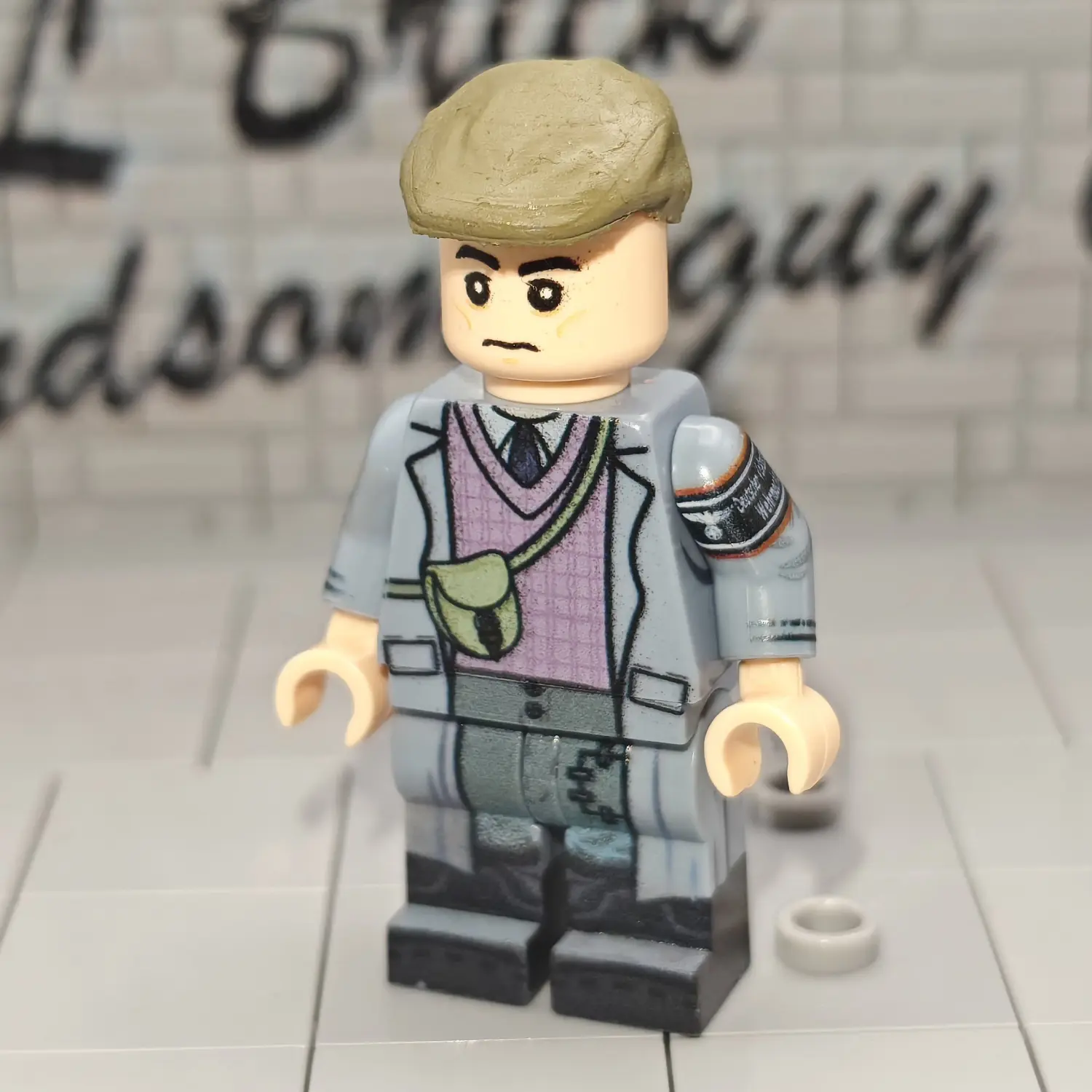
This custom building block minifigure represents a WWII German Volkssturm Militia Member, specifically depicting a civilian conscript from the desperate late stages of the war. Visually, the character is dressed entirely in improvised civilian clothing rather than a standard military uniform, featuring a long light grey overcoat worn over a purple V-neck sweater, collared shirt, and dark tie. On his head, he wears a typical civilian tan flat cap—also known as a newsboy or ivy cap—which distinguishes him from the fedora-wearing variants. His trousers are grey and show printed patchwork and stitching details, heavily emphasizing the worn, everyday nature of his attire, and his outfit ends in standard black shoes. He carries a simple green canvas satchel or bread bag slung across his chest for basic supplies. The absolute most historically significant and identifying feature on this figure is the printed black, white, and red armband on his left sleeve, which clearly reads “Deutscher Volkssturm Wehrmacht”.
Historically, the Volkssturm (People’s Storm) was a national militia established by Nazi Germany during the final months of World War II, specifically from late 1944 to 1945. As the regular army was completely decimated by the advancing Allied and Soviet forces, the government forcibly conscripted all remaining men between the ages of 16 and 60 who were not already serving. Because of severe late-war supply shortages, these civilian soldiers were almost never issued standard field uniforms. Instead, they fought in their everyday work clothes, winter coats, and civilian hats, exactly as brilliantly captured by this minifigure. To legally identify them as lawful combatants rather than illegal partisans liable to be executed upon capture, the state issued them the distinctive Volkssturm armband. These poorly trained and vastly under-equipped civilian militias were heavily utilized during the brutal, close-quarters street fighting in the Battle of Berlin. Due to extreme weapon shortages, they often fought with captured enemy equipment—such as the Soviet PPSh-41 submachine gun—or disposable anti-tank weapons, representing the tragic, catastrophic final collapse of the German forces.

Reviews
There are no reviews yet