

Character Identification
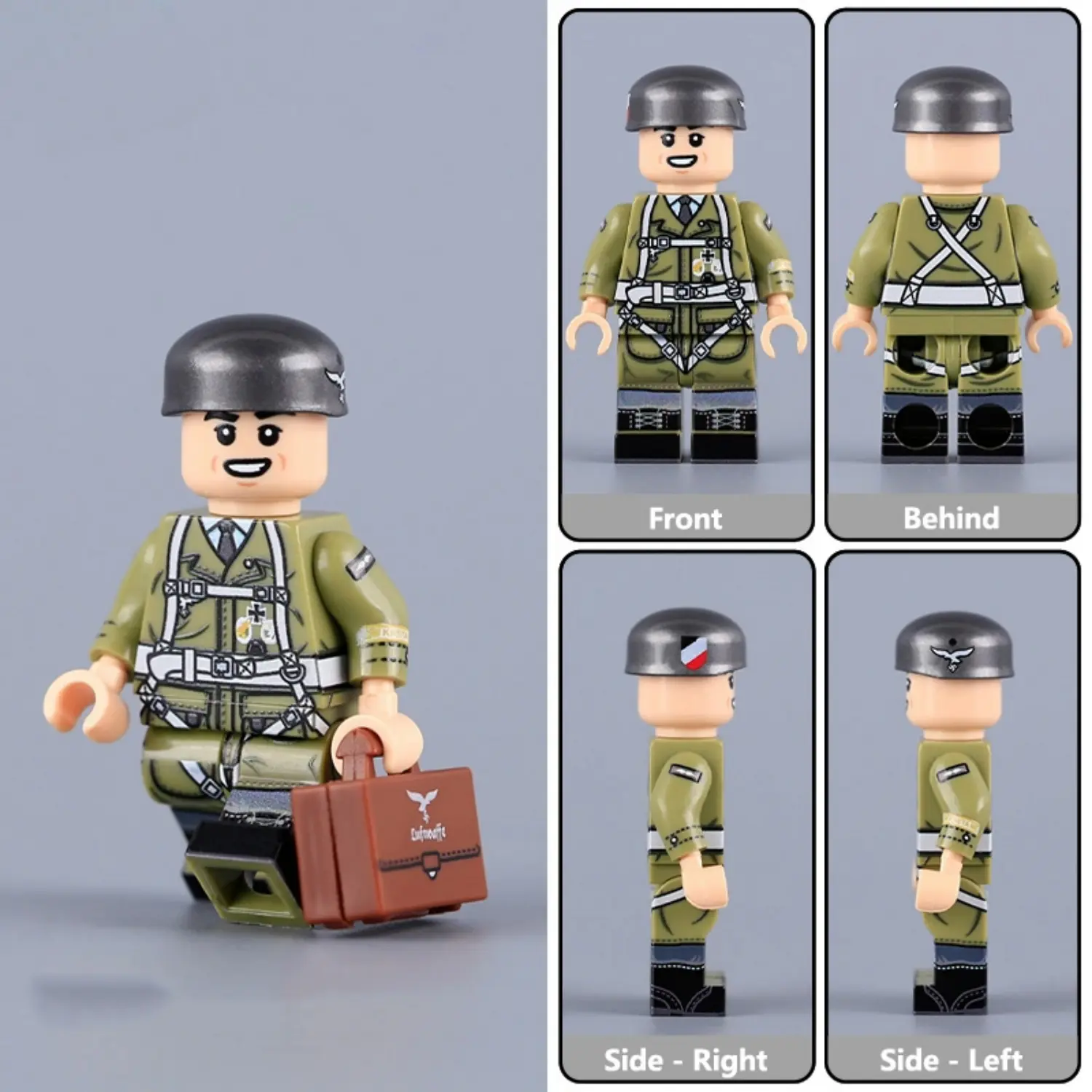
Specific Name: WWII German Luftwaffe Paratrooper Sergeant (Fallschirmjäger Unteroffizier) (Parade / Dress Uniform Variant)
The text explicitly labels this figure as a “Paratrooper Sergeant” and specifically denotes the uniform as “( Unteroffizier Paradeuniform )”, meaning a Non-Commissioned Officer in ceremonial or walking-out dress.
Visual Description
This custom-printed minifigure represents a member of the elite German airborne forces in a formal setting rather than combat.
-
Headgear: He wears the iconic M38 Paratrooper Helmet (Fallschirmjägerhelm). It is distinctively rimless (unlike the flared infantry helmet) to prevent injury during jumps. It features the National Tricolor Shield (Black-White-Red) decal on the right side and the Luftwaffe Eagle decal on the left side.
-
Uniform: He is dressed in the Luftwaffe Tropical/Field Tunic in olive green. Uniquely, he is wearing a Black Tie and collared shirt underneath, which signifies this is a Parade or Service Uniform rather than combat gear.
-
Insignia (Key Historical Detail):
-
Cuff Title: On his left sleeve, there is a bright yellow cuff band with the text “KRETA”. This is the Kreta Commemorative Cuffband, awarded to all personnel who participated in the airborne invasion of Crete in May 1941.
-
Chest: He wears the Luftwaffe Eagle on his right breast and the Iron Cross 1st Class on his left pocket.
-
-
Equipment:
-
Webbing: He wears bright White Leather Y-Straps and belt. In military modeling and toy design, white leather is traditionally used to represent “Parade” or “Guard” duty equipment to look smarter and more formal than standard brown/black combat gear.
-
Accessory: He holds a brown Briefcase printed with the Luftwaffe Eagle and text, suggesting an administrative or courier role for this specific figure.
-
Historical Background
-
The Battle of Crete (Operation Mercury): The “KRETA” band is the most significant historical marker on this figure. The invasion of Crete in 1941 was the first major airborne invasion in history. While it was a German victory, the Fallschirmjäger suffered such devastating casualties that Hitler forbade any large-scale airborne operations for the rest of the war.
-
The Unteroffizier: As a Sergeant (NCO), this soldier would have been a squad leader. The mix of the M38 combat helmet with the formal tie and white parade belt creates a “victory parade” aesthetic, likely representing a soldier returning from the Crete campaign or serving on guard duty at a Luftwaffe base.
Reviews
There are no reviews yet