

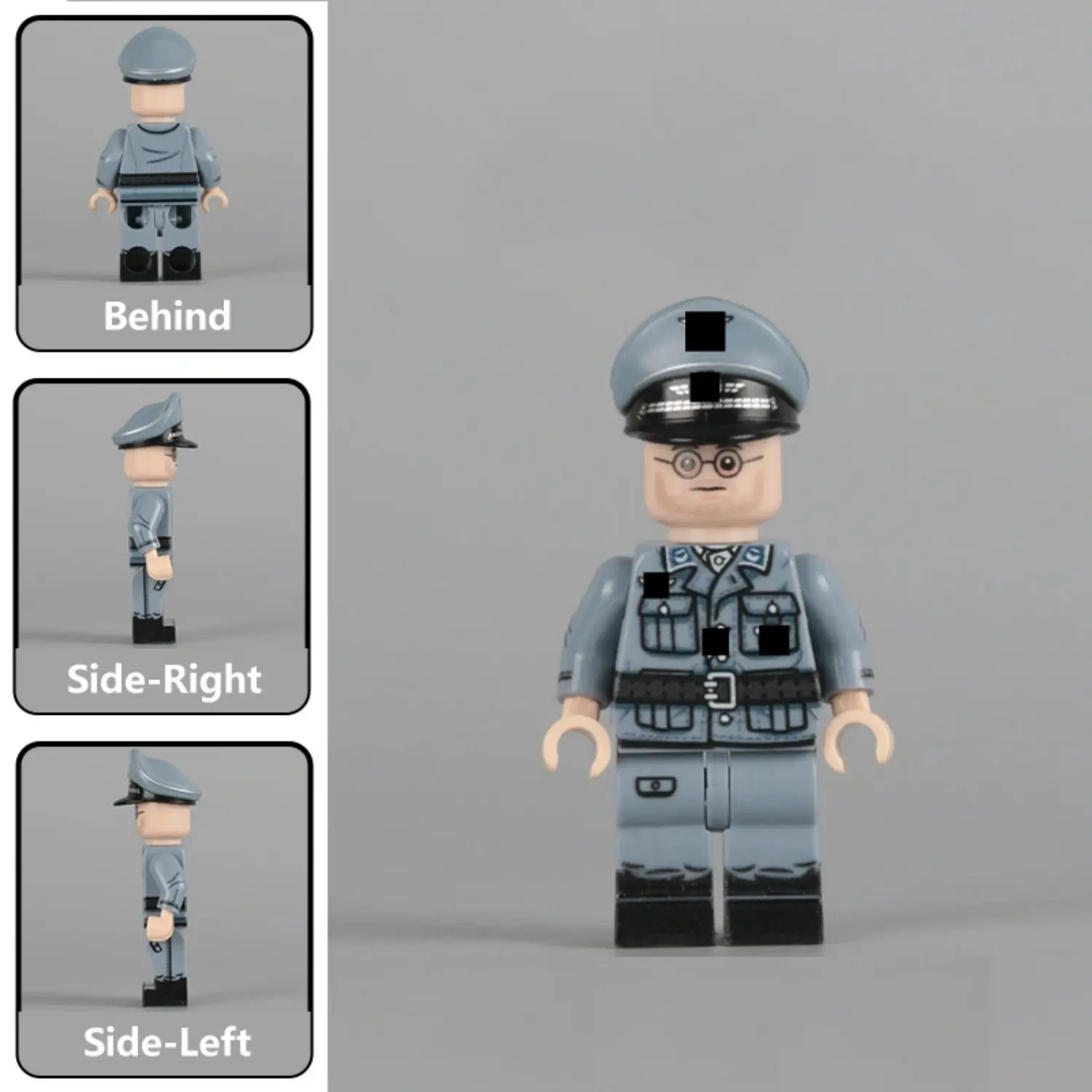
Character Identification: WWII German Luftwaffe (Air Force) Medical Officer
This custom building block minifigure represents a commissioned medical officer serving in the German Air Force (Luftwaffe) during World War II. According to the manufacturer’s text in the image, his specific rank and role is a Second Lieutenant Medic Officer.
Specific Name and Uniform Details
-
Specific Name: WWII German Luftwaffe Second Lieutenant Medic Officer (Leutnant der Sanitätstruppe)
-
The “Air Force Blue” Tunic: The figure is dressed in the standard blue-grey (blaugrau) service tunic equipped with four pleated pockets and a silver-buckled black leather waist belt. This distinct color universally identified Luftwaffe personnel, separating them from the field-grey of the regular Army.
-
Headgear: He is wearing a blue-grey Officer’s Peaked Cap (Schirmmütze). The cap features silver chin cords across the front, which was the standard indicator of a commissioned officer’s rank (Lieutenants to Colonels).
-
Branch Insignia (Blue Collar Tabs): The most historically significant detail regarding his specific role is found on his collar. He wears blue collar tabs (Kragenspiegel). In the German military’s color-coded branch system (Waffenfarbe), cornflower blue (Kornblumenblau) was strictly assigned to the Medical Corps (Sanitätstruppe).
-
Facial Features: The figure features a printed face with round spectacles (glasses) and light stubble, giving him an educated, intellectual appearance fitting for a military doctor or surgeon.
-
Footwear: He wears standard dark grey trousers and printed black officer boots.
Historical Background
During World War II, the Luftwaffe maintained its own dedicated medical branch, the Sanitätstruppe. While the regular Army (Heer) handled the bulk of ground casualties, the Luftwaffe required highly specialized medical personnel.
Medical officers (doctors and surgeons) holding the rank of Second Lieutenant (Leutnant) or higher were responsible for the health and psychological well-being of pilots and aircrews, dealing with the unique traumas of aerial warfare, such as high-altitude frostbite, severe burns, and hypoxia.
However, Luftwaffe medics did not just serve in safe hospitals or on airbases. As the war progressed, they were heavily deployed to the front lines alongside Luftwaffe Field Divisions, Anti-Aircraft (Flak) batteries, and elite Fallschirmjäger (Paratrooper) units. These frontline doctors operated under extreme combat conditions, wearing uniforms identical to the combat troops they treated, distinguished only by their blue collar tabs and medical armbands.
Reviews
There are no reviews yet