

Character Identification
Specific Name: WWI British Royal Naval Division (RND) Soldier / Royal Marine (The “Winston’s Little Army” Era)
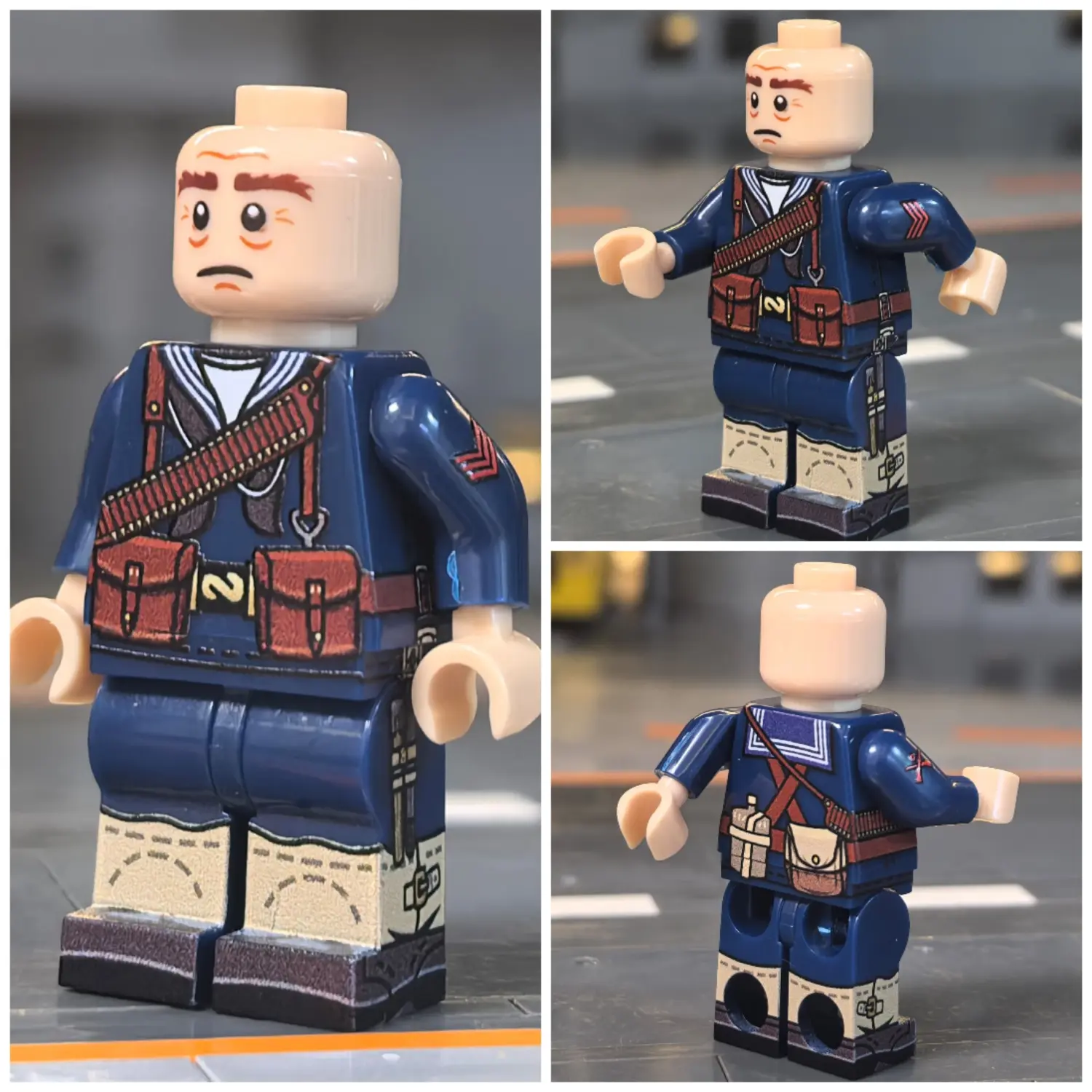
This figure represents a member of the British Royal Naval Division or a Royal Marine Light Infantry (RMLI) landing party during the early stages of World War I (circa 1914-1915). This specific look—wearing a blue naval uniform with infantry combat gear—is iconic to the Siege of Antwerp or the early Gallipoli Campaign, where sailors and marines fought on land before fully switching to standard army khaki.
Visual Description
This custom-printed minifigure captures the unique hybrid appearance of a sailor fighting as a foot soldier:
-
Uniform (The “Bluejackets”): He wears a dark Navy Blue Tunic and trousers.
-
Sailor Collar: The most distinct feature is the Square Sailor’s Collar (Jean Collar) with white piping visible on the back and around the neck. This immediately identifies him as naval personnel rather than a regular army soldier.
-
-
Combat Gear:
-
Bandolier: A brown leather Ammunition Bandolier is strapped diagonally across his chest. This was standard issue for cavalry and naval infantry to carry extra rifle rounds.
-
Webbing: He wears a brown leather belt with Ammo Pouches (marked with a “2”) and suspenders.
-
-
Insignia:
-
Rank: On his left arm, there are Red Chevrons (Stripes), indicating he holds a non-commissioned officer rank, such as a Corporal or Petty Officer.
-
Symbol: On the back of the right arm, there is a small red insignia that resembles crossed anchors or a specialized naval trade badge.
-
-
Legs:
-
Gaiters: He wears light tan/khaki Canvas Gaiters (Spats) over his boots. This was a distinctive part of the Royal Navy landing rig, used to secure the trousers for marching on land.
-
-
Accessories: The rear view shows a water canteen and a small haversack attached to his belt, essential for infantry operations.
Historical Background
-
The Royal Naval Division (RND): Formed in 1914 by Winston Churchill (then First Lord of the Admiralty), this unit was created from the surplus of naval reservists who had no ships to serve on.
-
“Soldiers at Sea”: They were organized into battalions named after famous admirals (Drake, Nelson, Hawke) and treated as infantry.
-
The Look: In the early battles like the defense of Antwerp (1914), they famously went to war in their blue naval uniforms, carrying old rifles and wearing canvas gaiters, exactly as depicted by this figure. Later in the war (like at the Somme), they switched to standard Army Khaki, making this “Blue” version a specific early-war collector’s item.

Reviews
There are no reviews yet