

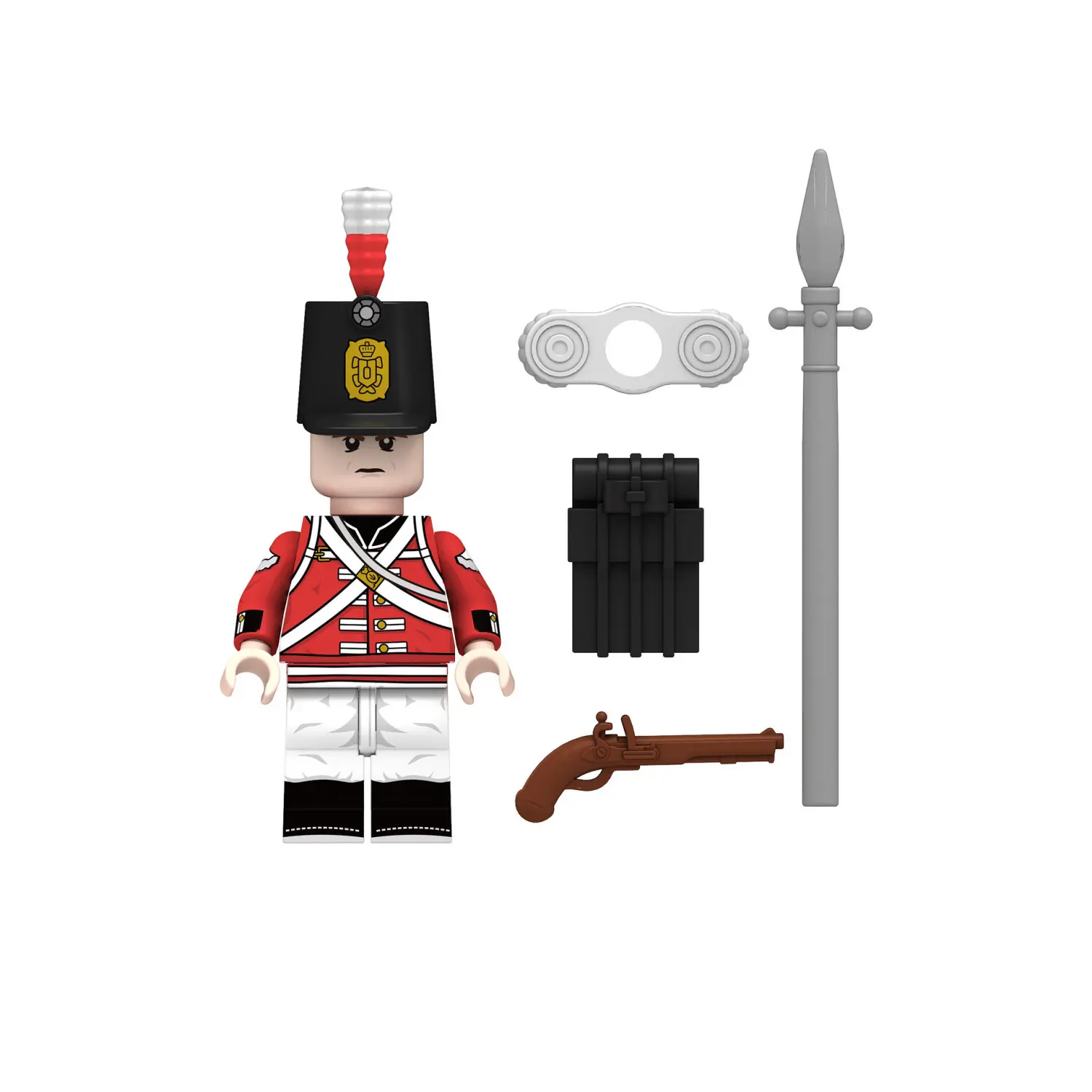
This image displays a toy minifigure representing a British Army “Redcoat” Soldier, specifically a Sergeant of the Line Infantry, from the Napoleonic Wars era (early 19th Century).
Here is a detailed breakdown of the figure and its historical context:
The Figure: British Redcoat Sergeant The figure is dressed in the iconic uniform that gave British soldiers their nickname: “The Redcoats.”
-
Uniform: He wears the traditional scarlet red tunic with white cross-straps (belts) across the chest. These straps held ammunition and equipment. He is wearing white trousers and black boots, which was the standard dress for British infantry fighting in Europe (like at the Battle of Waterloo).
-
Headgear: He is wearing a Shako, a tall, cylindrical military cap. It features a brass plate on the front (which would historically display the regiment’s number) and a red and white plume (hackle) on top. This specific style looks like the “Stovepipe” or “Belgic” Shako used during the fight against Napoleon.
-
Rank and Role: The key indicator of his specific rank is the weapon he is holding. It is a Spontoon (or Pike/Halberd), a long polearm with a spearhead. During the Napoleonic Wars, Sergeants carried these long spears not just for fighting, but to physically push their own soldiers’ muskets into line and keep the formation straight during battle. Officers carried swords, and privates carried muskets, so the pike identifies him as a Sergeant.
-
Accessories: The set includes a Flintlock Pistol (an early black powder handgun), a black backpack (knapsack) for carrying supplies, and a separate white piece that represents epaulettes (shoulder scales) which can be attached to the uniform.
Historical Background: This soldier represents the backbone of the British Army under the Duke of Wellington. These men are famous for defeating Napoleon Bonaparte at the Battle of Waterloo in 1815. They were renowned for their iron discipline and their ability to stand calm in a “Thin Red Line” while being charged by enemy cavalry or fired upon by artillery. They used the “Line” formation to maximize their firepower, firing volleys of musket balls at the enemy.
Reviews
There are no reviews yet