

Character Identification: WWII Imperial Japanese Army Infantryman
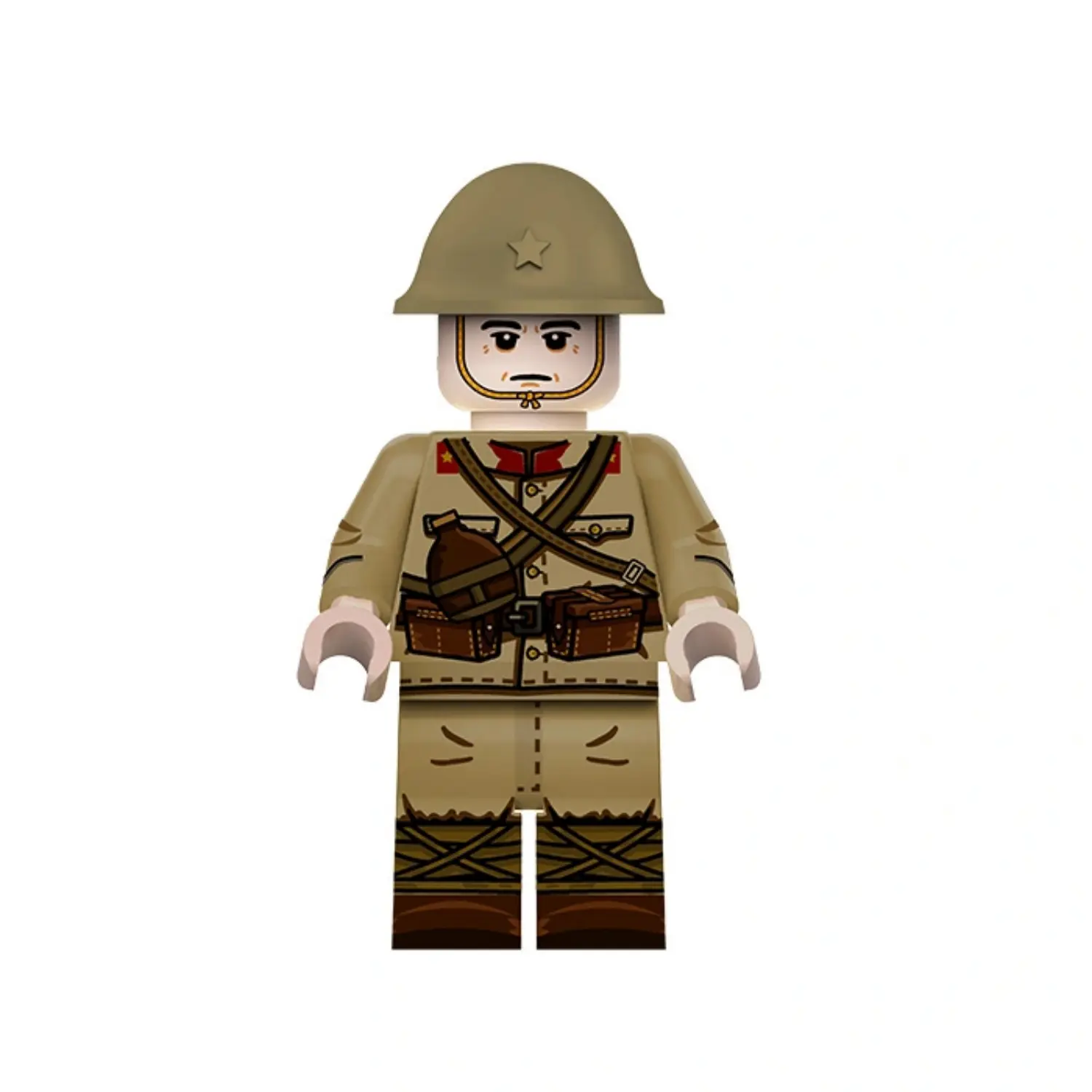
This custom-printed building block minifigure represents a frontline enlisted soldier of the Imperial Japanese Army (IJA) during World War II. The uniform, headgear, and equipment are highly characteristic of the Japanese forces that fought across the Pacific Theater and mainland Asia during the late 1930s and 1940s.
Specific Name and Visual Details
-
Specific Name: WWII Imperial Japanese Army (IJA) Infantry Soldier
-
Headgear (The Type 90 Helmet): The figure is wearing a distinctive khaki/olive-drab helmet featuring a flared rim and a prominent five-pointed star on the front. This accurately represents the Type 90 Steel Helmet (Tetsubou), the standard-issue combat helmet of the Japanese military. A chin strap is also printed directly onto the figure’s face to secure it.
-
Facial Features: The printed face shows a stern, disciplined expression, representing a typical enlisted soldier.
-
The Uniform (Type 98): He is dressed in a khaki/mustard-yellow tunic and trousers. This represents the Type 98 Uniform (M98), which was introduced in 1938 and became the standard field dress for the IJA throughout the remainder of the war.
-
Insignia (Collar Tabs): On the collar of the tunic are two printed red collar tabs, each bearing a single gold star. In the Japanese Army ranking system, the color red specifically designated the Infantry branch, while the single star indicates the rank of a junior enlisted soldier, such as a Private Second Class.
-
Tactical Webbing and Gear: * Strapped diagonally across his chest is a brown military canteen (water flask).
-
Around his waist is a brown leather combat belt featuring a metal buckle and two distinct brown leather ammunition pouches on the front, used to hold stripper clips for the standard Arisaka rifle.
-
-
Lower Body and Footwear: The lower legs feature a printed criss-cross pattern representing Kyahan (cloth puttees/leg wraps). These were tightly wrapped around the shins over the trousers to provide support and keep out jungle debris or mud. He wears standard brown leather infantry boots.
Historical Background
During World War II, the Empire of Japan was the primary Axis power in the Pacific. The Imperial Japanese Army engaged in a massive and brutal series of campaigns ranging from the harsh winters of Manchuria and China to the sweltering, disease-ridden jungles of Southeast Asia and the Pacific Islands.
-
The Japanese Infantryman: The standard Japanese infantryman was known for his extreme discipline, endurance, and willingness to fight to the death due to the strict militaristic code instilled in the armed forces. They often operated with lighter logistical support than their Western counterparts, relying heavily on speed and nighttime infiltration tactics.
-
The Equipment: The gear depicted on this minifigure—specifically the Type 98 uniform and the Type 90 helmet—was designed to be functional across diverse climates. However, as the war dragged on and Japan’s supply lines were severed by Allied naval blockades, soldiers often suffered from severe shortages of food, ammunition, and proper jungle equipment.
-
War Correspondents: Regarding the file name’s mention of a “War Correspondent,” Japanese journalists (Jūgun kisha) did accompany troops to the front lines to document the war for propaganda purposes. However, they were typically required to wear standard military uniforms identical to the soldiers to blend in, which perfectly explains why this figure looks exactly like a regular infantryman.
Reviews
There are no reviews yet