

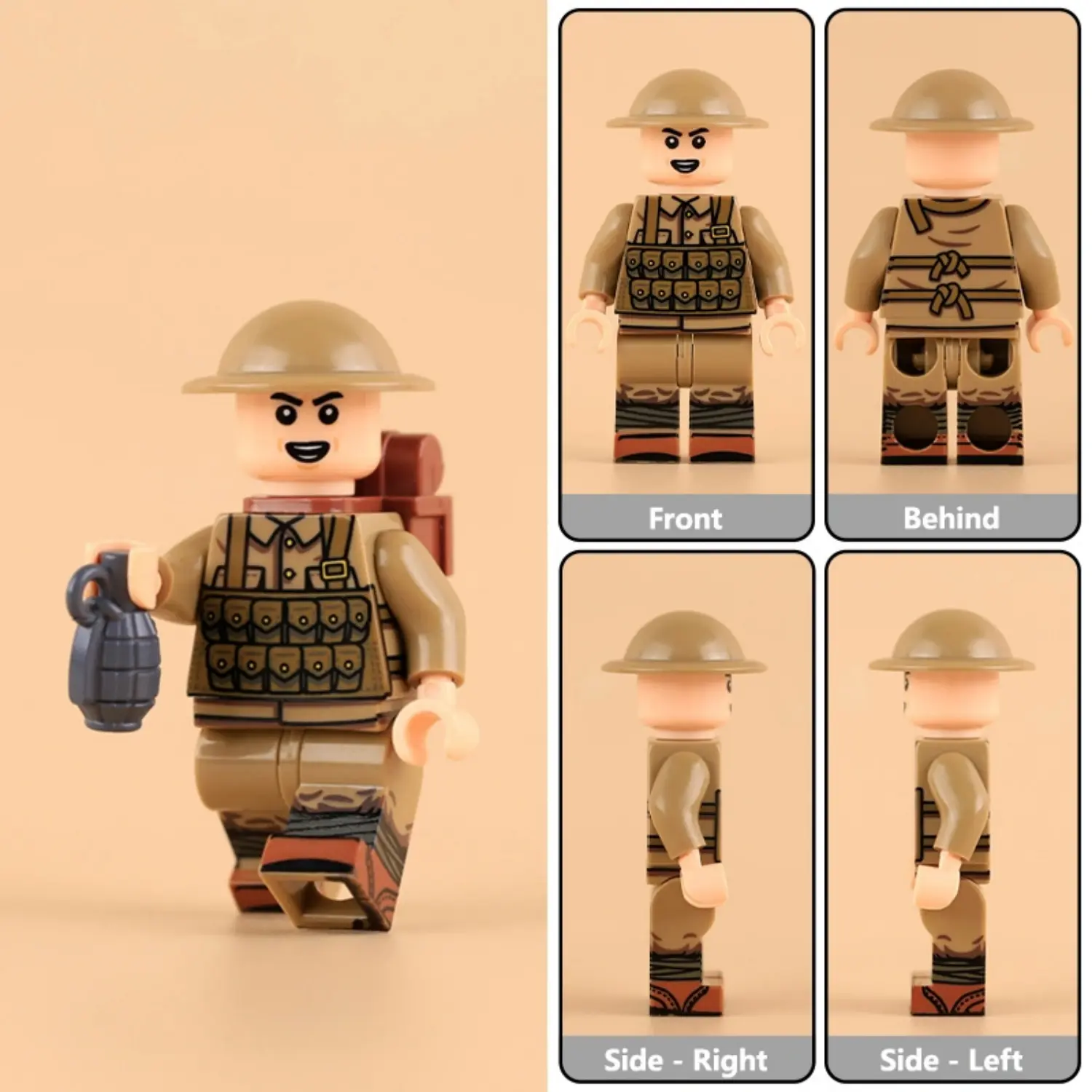
Character Identification: WWI British Army Trench Grenadier
This custom-printed building block minifigure represents a highly specialized shock troop of the British Army during World War I (The Great War). Identified by the text in the image and his highly distinct canvas chest rig, this soldier is a Trench Grenadier—officially referred to in the British military at the time as a “Bomber.” His primary role was to lead aggressive trench raids and clear enemy dugouts using high explosives.
Specific Name and Visual Details
-
Specific Name: WWI British Army Trench Grenadier / “Bomber” (with Grenade Vest)
-
Headgear (The Brodie Helmet): The figure wears the standard olive-drab Brodie Helmet (often called the “tin hat”), explicitly designed with a wide brim to protect soldiers from overhead shrapnel in the trenches.
-
Facial Features: He features a fierce, shouting expression with a wide-open mouth, perfectly capturing the intense, adrenaline-fueled chaos of a close-quarters trench assault.
-
The Uniform: He is dressed in the standard British Khaki Service Dress tunic and trousers.
-
Tactical Webbing and Gear (The Grenade Vest):
-
Front Gear: Instead of standard rifle ammunition pouches, this figure wears a specialized canvas grenade waistcoat/vest. The printing shows multiple rows of distinct, buttoned pockets covering his entire chest and stomach. This is a highly accurate historical detail, as these vests were designed to securely carry a dozen or more heavy hand grenades.
-
Back Gear: The rear view reveals a simple, functional design: the heavy canvas vest is secured tightly to his body by two tied fabric knots across his back.
-
-
Footwear (Puttees): His lower legs feature printed khaki puttees (cloth leg wrappings) worn over standard brown infantry boots, an essential piece of gear to combat the horrific mud and water of the Western Front.
-
Weapon (The Mills Bomb): In the action pose, the figure wields a dark grey, textured hand grenade accessory. This represents the iconic British Mills bomb (specifically the No. 5 or No. 36 Mk. 1), which was the standard fragmentation grenade of the British Empire. He also wears a brown brick-built knapsack in this pose.
Historical Background
During World War I, the stagnant, heavily fortified nature of trench warfare rendered traditional infantry charges disastrous. To break the deadlock, armies had to develop new close-quarters tactics and weapons.
-
The Rise of the “Bombers”: In the narrow, zigzagging confines of an enemy trench, the standard-issue long rifle with a bayonet was often too clumsy and slow. The hand grenade quickly became the ultimate trench-clearing weapon. The British Army formed specialized squads of “Bombers.” These were physically strong, brave soldiers trained to run forward under fire and lob explosives into enemy pillboxes, machine-gun nests, and dugouts before the regular riflemen moved in to secure the area.
-
The Grenade Vest: A standard British Mills bomb weighed roughly 1.25 pounds (0.5 kg). A Bomber needed to carry as many of these as possible into a raid without them banging together dangerously or weighing down his arms. The solution was the canvas grenade waistcoat (as perfectly depicted on this minifigure). It distributed the heavy weight across the torso and freed up the soldier’s hands for climbing over barbed wire and throwing explosives.
-
The Mills Bomb: Invented by William Mills in 1915, this was the classic “pineapple” grenade. Its heavily grooved cast-iron body was designed to fragment into lethal shrapnel upon detonation. It was arguably the most successful and widely used grenade of the First World War.
Reviews
There are no reviews yet