

Variations
Introduction
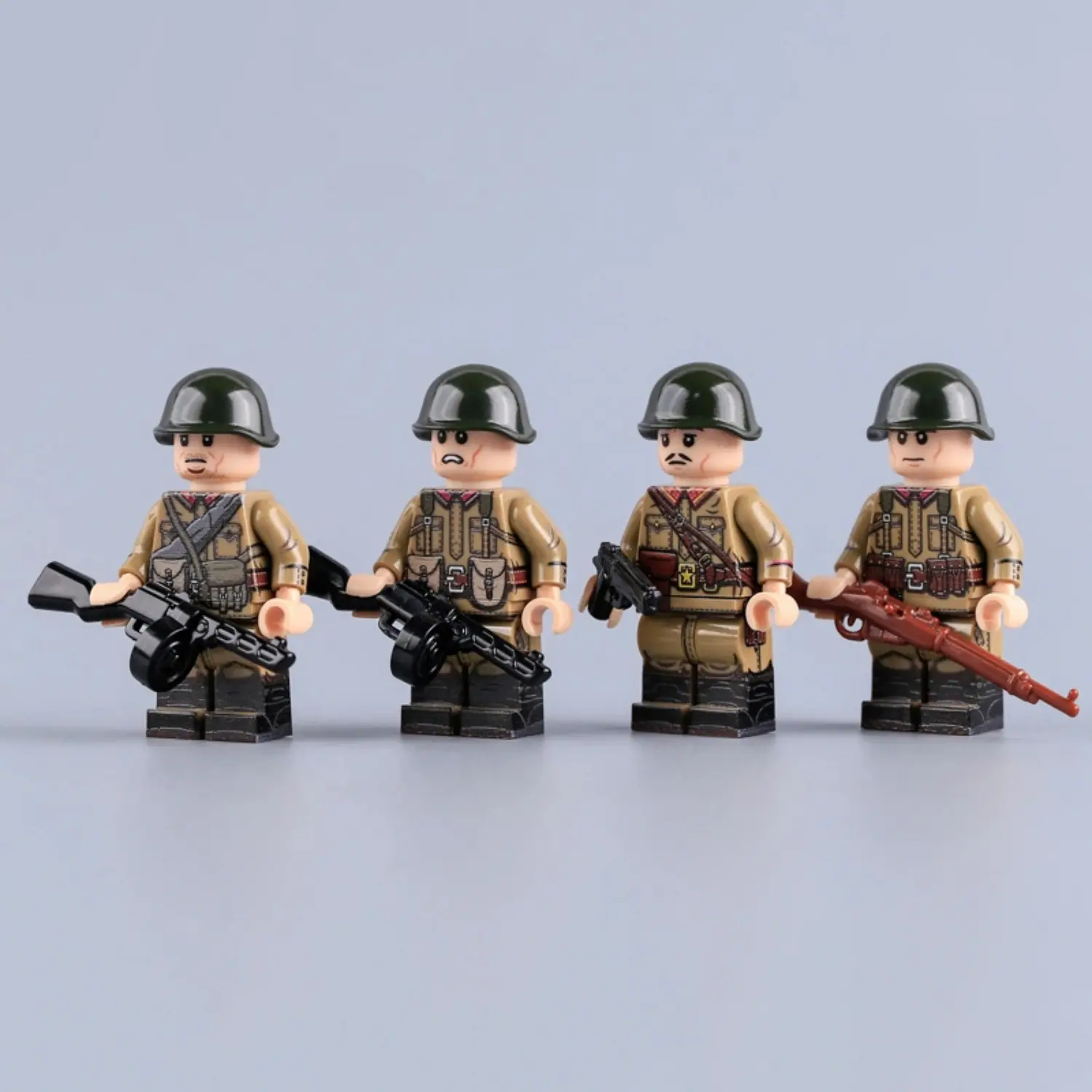
Group Identification: WWII Soviet Red Army Infantry Squad (Early/Mid-War)
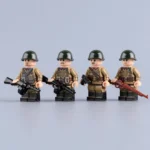
This image displays a complete 4-piece set of custom-printed building block minifigures representing a combat squad of the Soviet Red Army during World War II. They are all depicted wearing the early-to-mid-war Model 1935 (M35) Gymnastiovka uniforms, identifiable by the distinctive rank and branch insignia worn on the collar rather than the shoulders.
Here is a detailed, one-by-one breakdown of the figures, reading from left to right:
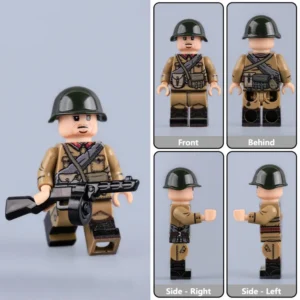
1. Far Left: The Veteran Submachine Gunner (with Bedroll)
-
Specific Name: WWII Soviet Red Army Submachine Gunner (Avtomatchik) with Skrutka
-
Visual Details: This figure features a gritty, stubbled face with a combat scar. He wears the standard olive-green SSh-40 steel helmet. Across his chest, he wears a diagonally rolled greyish-blue greatcoat or shelter half, known in Russian as a “Skrutka”. This practical method of carrying gear freed up the soldier’s hands for combat.
-
Weapon: He is armed with the iconic black PPSh-41 Submachine Gun equipped with a high-capacity drum magazine.
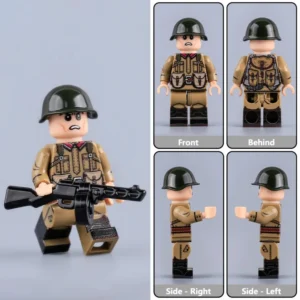
2. Mid-Left: The Assault Submachine Gunner (with Drum Pouches)
-
Specific Name: WWII Soviet Red Army Submachine Gunner (Avtomatchik) with Drum Pouches
-
Visual Details: This soldier is depicted with an aggressive, shouting expression, leading an assault. He wears the same M35 uniform with red infantry collar tabs. Instead of a bedroll, he wears a combat belt equipped with two large, specialized canvas drum magazine pouches. These wide pouches were specifically designed to carry the heavy 71-round drums for his weapon.
-
Weapon: He is also armed with the PPSh-41 Submachine Gun, the devastating close-quarters weapon of the Soviet shock troops.
3. Mid-Right: The Commanding Officer / Political Commissar
-
Specific Name: WWII Soviet Red Army Officer / Commander
-
Visual Details: This figure represents unit leadership. He features a stern mustache and a facial scar. His M35 collar tabs feature gold trim, distinguishing him as an officer. He wears a distinct brown leather diagonal cross-strap harness over his tunic. On his right hip is a printed leather pistol holster, and his belt buckle features a gold Soviet star.
-
Weapon: Unlike the enlisted men, he is armed with a sidearm—the standard Tokarev TT-33 semi-automatic pistol, which officers used to direct troops and maintain discipline.
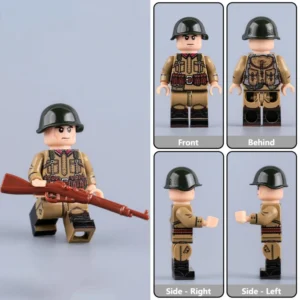
4. Far Right: The Standard Rifleman
-
Specific Name: WWII Soviet Red Army Standard Rifleman
-
Visual Details: This figure represents the backbone of the Soviet military. He wears the standard M35 uniform and SSh-40 helmet. His combat belt is equipped with standard brown leather dual-ammunition pouches, which were rigidly structured to hold 5-round stripper clips.
-
Weapon: He is armed with a long, brown bolt-action rifle, accurately representing the legendary Mosin-Nagant M91/30, the primary infantry rifle of the Soviet forces throughout the war.
Historical Background
During World War II (known in the USSR as the Great Patriotic War), the Red Army bore the brunt of the massive land war on the Eastern Front. This minifigure set beautifully captures a historically accurate cross-section of a Soviet infantry unit during the critical early years of the conflict (1941 to early 1943).
-
The M35 Uniform and Collar Tabs: Before early 1943, Soviet soldiers did not wear shoulder boards. Instead, their rank and branch were displayed on their collar tabs (petlitsy). The red tabs with black piping seen on these figures officially designated the Infantry. After the victory at Stalingrad, the Soviets reformed their uniforms, making these specific M35 tunics a hallmark of the desperate early defenses of Moscow and Stalingrad.
-
The Rise of the Submachine Gun: The Red Army heavily utilized submachine guns to counter German tactical superiority. The PPSh-41 was cheap to produce and incredibly effective in the ruined, claustrophobic streets of urban combat. The Soviets formed entire platoons of Avtomatchiki (Submachine Gunners) to lay down walls of suppressive fire, while standard Riflemen provided long-range accuracy with their Mosin-Nagants.
-
Leading from the Front: The Officer figure accurately reflects the gear of Soviet commanders, who frequently led charges from the front lines armed only with their Tokarev pistols, making them highly visible targets but essential for unit morale.
Reviews
There are no reviews yet