

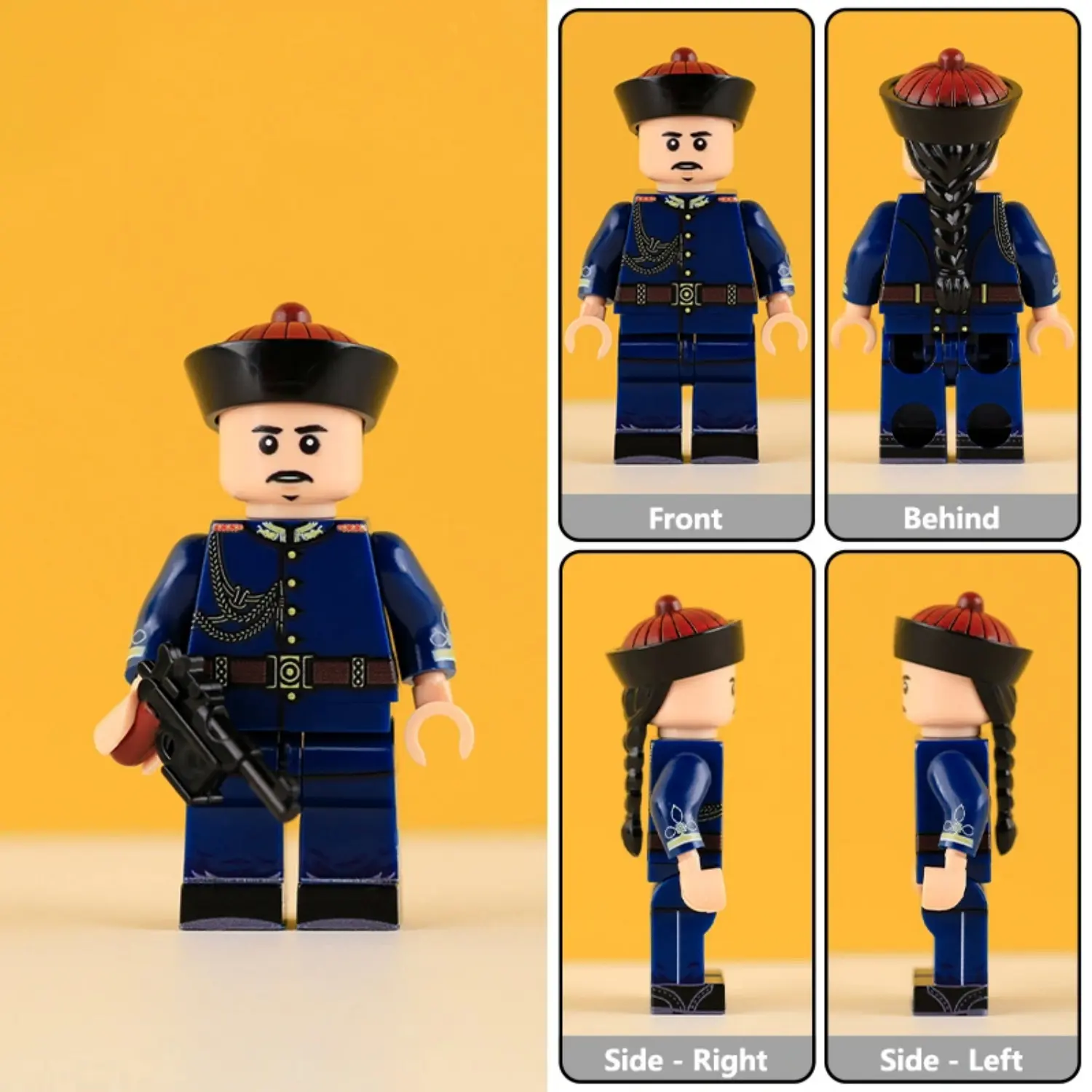
Character Identification
Specific Name: Late Qing Dynasty Cavalry Officer (Imperial New Army Horse Soldier)
The text on the image explicitly labels this figure as “MTUV100 Qing Dynasty Cavalry Officer”. This figure represents a specialized commander within the mounted branch of the modernized “New Army” (Lujun) during the final years of the Qing Dynasty.
Visual Description
This custom-printed minifigure features distinct details that separate him from the infantry and medical officers:
-
The Aiguillette (Key Distinction): The most defining feature of this officer’s uniform is the Gold Braided Cord (Aiguillette) draped across his right chest/shoulder area. In military history, these cords often denoted an officer of the cavalry, a staff officer, or an adjutant. It adds a level of ceremonial prestige to the uniform.
-
Uniform: He wears the Dark Blue New Army Tunic. Unlike the double-breasted coats of the other officers, his tunic features this elaborate braiding, mimicking the hussar-style flourishes often seen in European cavalry uniforms of the 19th century.
-
Headgear: He wears the standard Official’s Hat with a red finial (knob) and upturned brim, maintaining the required Manchu court dress code.
-
The Queue: The rear view shows the mandatory Manchu Pigtail (Queue), symbolizing his subjection to the Qing Emperor.
-
Weapon: He is armed with a black Mauser C96 Pistol (Broomhandle). This was a prized weapon for cavalry officers as its semi-automatic fire was ideal for use while on horseback compared to bolt-action rifles.
-
Legs: He wears blue trousers and black riding boots.
Historical Background
-
The New Army Cavalry: As part of the Qing military modernization (after 1895), the cavalry was reorganized along German lines. However, they retained local characteristics, such as the queue and the official’s cap, creating a unique “East meets West” aesthetic.
-
The Mauser in China: The Mauser C96 became legendary in China. For a cavalry officer, it was a practical and powerful sidearm, effectively functioning as a compact carbine.
-
The Fall of the Empire: Officers like this would have been the ones debating whether to support the Wuchang Uprising in 1911. Many New Army officers eventually cut off their queues and joined the revolution, making this figure a snapshot of the very end of Imperial China.
Reviews
There are no reviews yet