

Character Identification
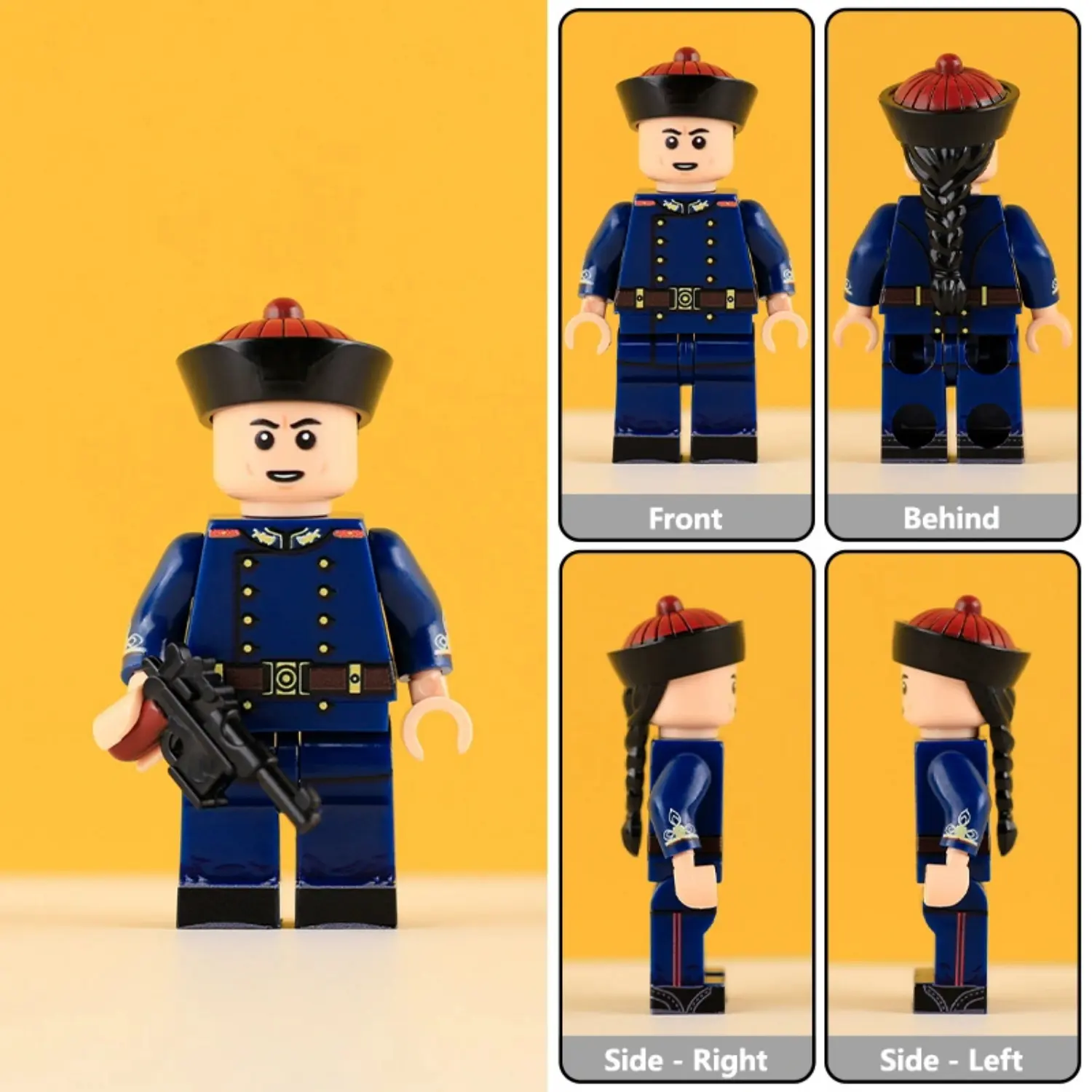
Specific Name: Late Qing Dynasty Infantry Officer (Imperial New Army Commander – MTUV099)
The text on the image explicitly labels this figure as “MTUV099 Qing Dynasty Infantry Officer”. This figure represents a commanding officer in the modernized “New Army” (Lujun) established towards the end of the Qing Dynasty (late 19th/early 20th Century).
Visual Description
This custom-printed minifigure accurately depicts the unique transitional style of the late Imperial Chinese military:
-
Uniform (The “New Army” Style): He wears a Dark Blue Double-Breasted Tunic with two rows of brass/gold buttons. This uniform was part of the modernization reforms, copying German and Japanese military styles of the era, contrasting sharply with the traditional silk robes of the past.
-
Headgear: Despite the modern uniform, he retains the traditional Official’s Hat (Manchu cap) with an upturned brim and a red finial (knob) on top. This signifies his loyalty to the Qing Emperor.
-
The Queue: The back view reveals the mandatory Manchu Queue (Braided Pigtail) running down his spine. This hairstyle was enforced by law until the 1911 Revolution.
-
Weapon (The “Box Cannon”): He is holding a black Mauser C96 Pistol (often called the “Broomhandle” or Hezi Pao in China). This semi-automatic pistol was incredibly popular among Chinese officers and warlords, becoming a status symbol of authority.
-
Insignia: The collar features Red Tabs with Gold Embroidery. In the Qing New Army, red was the standard color for the Infantry branch.
-
Legs: He wears matching blue trousers with black boots, completing the officer’s field dress.
Historical Background
-
The New Army: Following defeats by foreign powers, the Qing Dynasty attempted to save the empire by creating a Western-style military called the “New Army.” These officers were often trained in military academies but were still subjects of the Manchu court.
-
The Mauser C96: The inclusion of the Mauser C96 is historically significant. China was the only country to use this pistol as a primary military sidearm on a massive scale. It bridges the gap between the fall of the Qing Dynasty and the rise of the Warlord Era.
-
End of an Era: This figure captures the specific moment in history just before the Xinhai Revolution (1911), where ancient traditions (the queue/hat) clashed with modern military technology (Mausers/uniforms).
Reviews
There are no reviews yet