

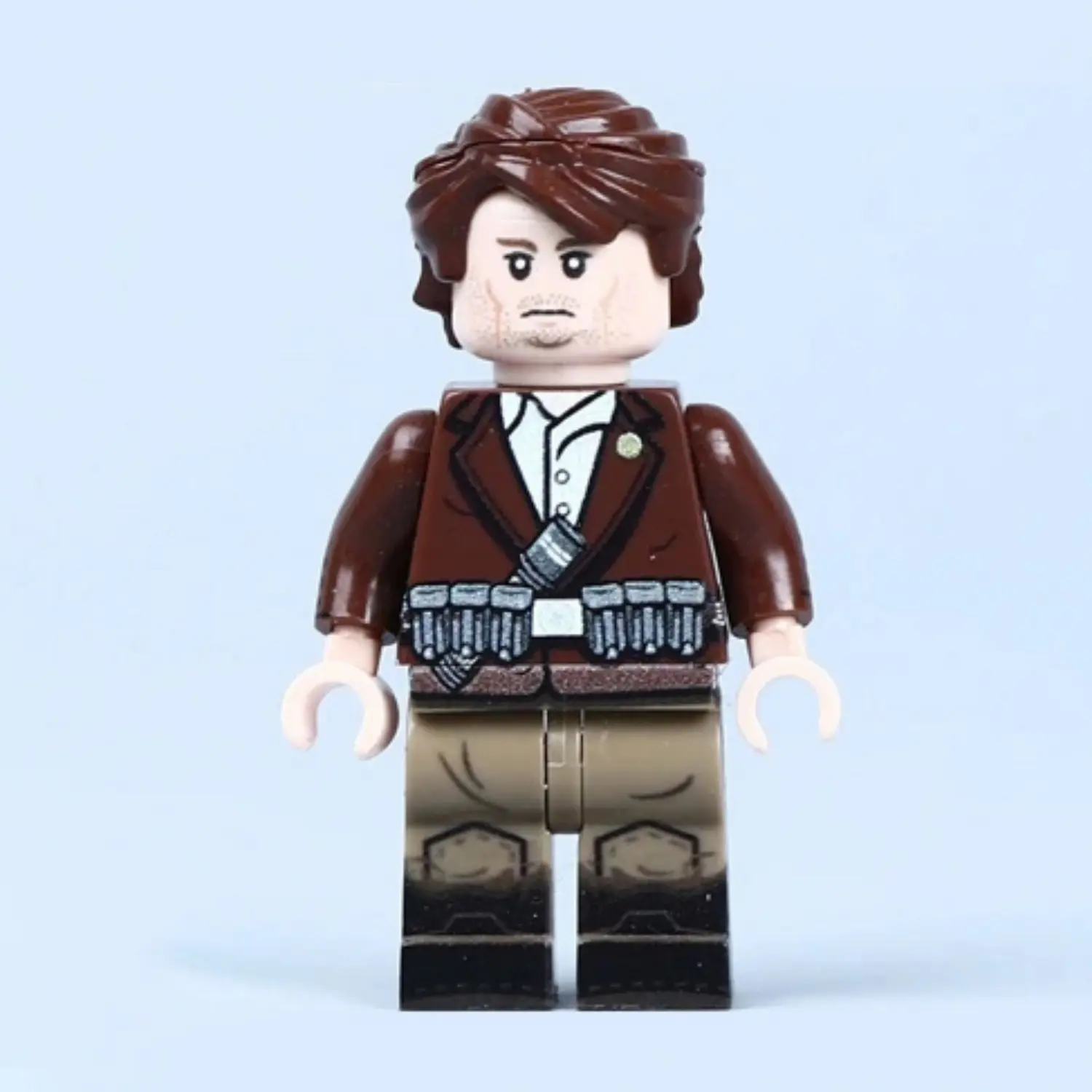
Character Identification
Specific Name: WWII Soviet Partisan / Resistance Fighter (Brown Jacket Variant)
This represents a guerrilla fighter from the Eastern Front of World War II, depicting a civilian or irregular soldier heavily armed for combat.
Visual Description
This custom-printed minifigure features a distinct design that highlights the rugged, non-uniformed nature of the resistance:
-
Head & Face: Unlike the other figures in this series who wear berets, this fighter is shown with messy brown hair, giving him a younger or more civilian appearance. His face features printed stubble/unshaven facial hair, representing the harsh living conditions in the forests or “Partisan Republics” where shaving was a luxury.
-
Torso & Clothing: He wears a Brown Civilian Jacket (possibly leather or heavy wool) over a white shirt.
-
Insignia: On his left lapel, there is a small printed Green/Gold Badge, possibly representing a Soviet award or a specific partisan unit insignia, indicating he is an organized fighter rather than a lone wolf.
-
-
Combat Gear:
-
Ammo Belt: The defining feature of this figure is the heavy Cartridge Belt wrapped around his waist. It is filled with silver rifle rounds (likely for a Mosin-Nagant), showing he is serving as a rifleman or sharpshooter.
-
Bandolier: A leather strap runs diagonally across his chest, likely supporting a weapon or map case on his back.
-
-
Legs: He wears Tan/Khaki Trousers with Black Boots. The boots feature “muddy” detailing near the bottom, emphasizing the rough terrain of the Russian countryside.
Historical Background
-
The “People’s Avengers”: Soviet partisans were often ordinary citizens—farmers, factory workers, or students—who took up arms against the German invasion. A figure like this, wearing civilian clothes but heavily laden with ammunition, perfectly captures that “citizen soldier” archetype.
-
Supply Scarcity: Partisans rarely had access to full uniforms. They wore warm civilian clothing (like the brown jacket seen here) and scavenged weapons and ammo belts from fallen soldiers or raided German depots.
-
The Badge: The presence of a badge on civilian clothes is historically significant. By 1943, the partisan movement was centrally controlled by Moscow. Many fighters were proud of their status and would wear badges or makeshift red stars to identify themselves as legitimate combatants of the Red Army, protecting them (in theory) under the laws of war.

Reviews
There are no reviews yet