


Character Identification
Specific Name: Qing Dynasty Imperial Army Bandsman / Trumpeter
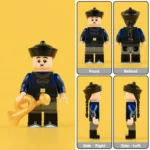
The text explicitly labels this figure as “MTUV097 Qing Dynasty Bandsman”. This represents a musician soldier from the Great Qing (1644–1912), the last imperial dynasty of China.
Visual Description
This custom-printed minifigure features distinct cultural attire that separates it from Western armies:
-
Headgear: He wears a traditional Qing Official/Soldier Hat (a style of Guanmao). It is black with an upturned brim and a small button knot on the top. This style was standard for government officials and military personnel.
-
Hair (Key Historical Feature): The back view reveals a long, braided Queue (Pigtail) hanging down his back. This is historically crucial: under the Qing Dynasty, all Han Chinese men were forced to shave the front of their heads and wear their hair in a queue as a sign of submission to Manchu rule.
-
Face: The face print features a unique expression with Puffed Cheeks and a small “x” mouth, simulating the physical action of blowing hard into a wind instrument.
-
Uniform: He wears a dark blue Magua (riding jacket) or traditional tunic with printed Frog Buttons/Knots on the chest. This was the standard everyday wear for soldiers and civilians of the era.
-
Accessory: He holds a large, gold-colored Trumpet or Bugle. In the context of the Qing military, horns and drums were the primary means of signaling commands (charge, retreat, gather) on the battlefield before modern radios.
Historical Background
-
The Queue Order: The braid seen on this figure represents one of the most strictly enforced laws in Chinese history. The phrase “Keep your hair and lose your head, or keep your head and cut your hair” defined the early Qing era. By the late 19th century (which this figure likely represents given the “modern” toy context), the queue had become a symbol of Chinese identity to the West, though it was originally a Manchu imposition.
-
Military Music: Unlike modern marching bands, Qing military musicians (bandsmen) played a functional tactical role. Loud brass horns (
Suonaor imported bugles) were used to cut through the noise of battle to relay the general’s orders to the troops. -
The Era: This figure likely depicts a soldier from the Late Qing Era (late 1800s), possibly from the “Green Standard Army” or early modernized units before the full switch to Western-style khaki uniforms in the 1900s.
Reviews
There are no reviews yet