

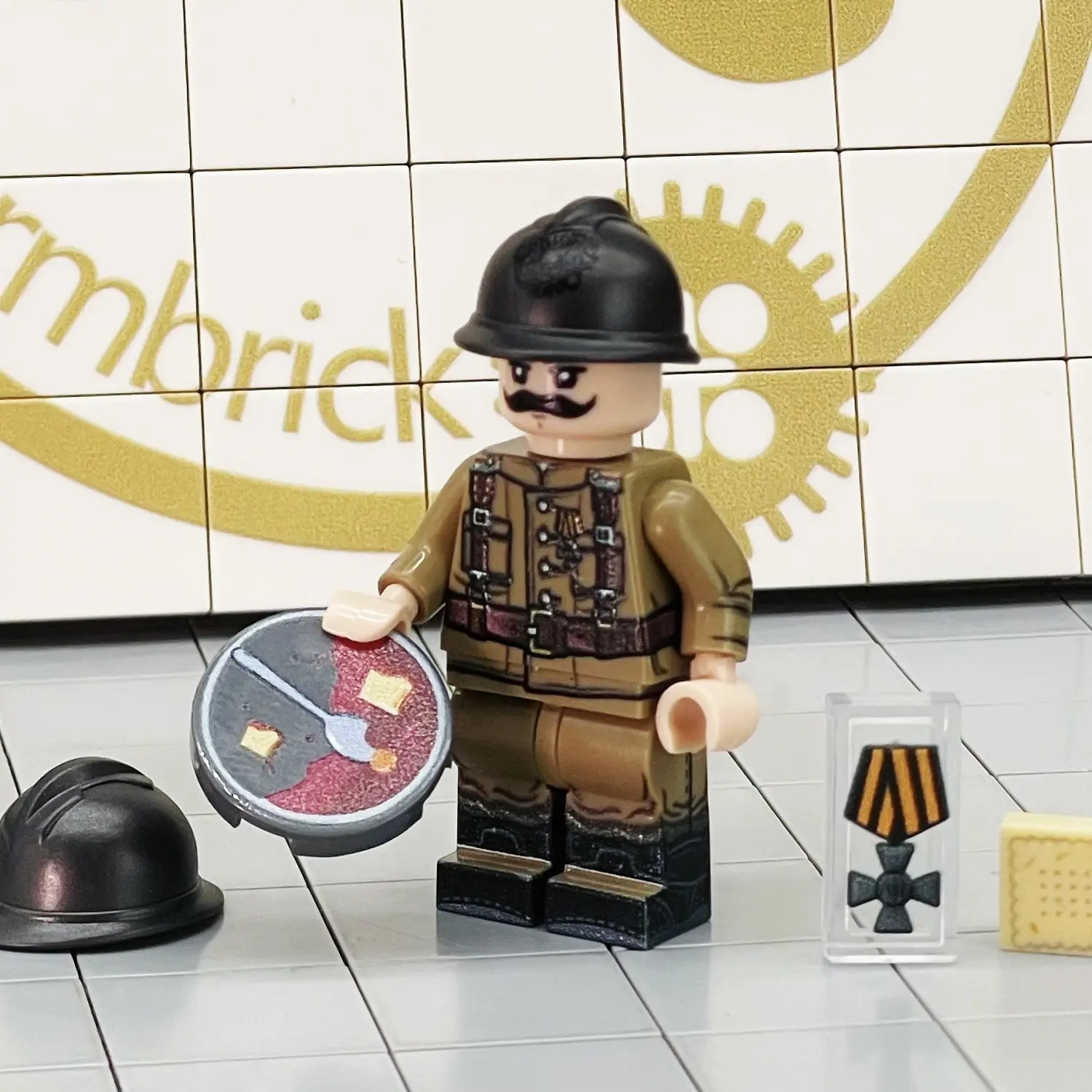
The Figure: WWI Russian Imperial Army Officer (Tsarist Russia)
This toy minifigure represents a historical officer or NCO of the Russian Imperial Army during World War I (1914–1917). The specific combination of equipment and accessories identifies him as a soldier fighting on the Eastern Front or perhaps as part of the Russian Expeditionary Force in France.
-
Headgear: He wears a black or dark green M1915 Adrian Helmet.
-
Historical Context: While the Adrian helmet is famous for being French, France supplied hundreds of thousands of them to their Russian allies during WWI. Russian troops stamped them with the Romanov Double-Headed Eagle (though this one appears plain/painted). It was the standard steel helmet for Russian shock troops and officers late in the war.
-
-
Uniform: He wears the traditional Russian “Gymnastirka” Tunic in a khaki/mustard color. The design features a high collar and a belt with shoulder straps, capturing the distinct look of the Tsarist military uniform before the 1917 Revolution.
-
Medal (Key Feature): Standing next to him (and printed on his chest) is a miniature replica of the Cross of St. George (Georgievskiy Krest).
-
Historical Significance: The accessory tile clearly shows the Orange and Black Striped Ribbon (Ribbon of Saint George) and the cross. This was the highest and most prestigious military decoration awarded to soldiers and non-commissioned officers in Imperial Russia for “undisputed gallantry” in the face of the enemy.
-
-
Accessory (Cultural Detail): In his right hand, he holds a round printed tile that depicts a Bowl of Borscht (Beet Soup).
-
Detail: The print shows the characteristic red soup with a dollop of white sour cream (smetana) and a spoon. This adds a unique cultural touch, representing the staple food of the Russian soldier.
-
-
Face: The figure sports a thick, curled Handlebar Mustache, a popular grooming style for officers of the era (resembling Tsar Nicholas II or military commanders of the time).
Historical Background: The Russian Imperial Army was the largest army in the world at the start of WWI, known as the “Russian Steamroller.” Despite immense bravery (symbolized by the St. George Cross) and early victories against Austria-Hungary, they suffered from supply shortages. The figure depicts a well-equipped late-war soldier (1916-1917) wearing foreign-aid equipment (the Adrian helmet) while retaining his distinctly Russian identity through his uniform and rations.

Reviews
There are no reviews yet